Table of Contents
ToggleStages of development of speech in children with normal hearing (typically developing children)
Pre-Linguistic Stage (Birth to 12 Months)
Before a child says their first “true” word, they go through several stages of vocal experimentation.
- Reflexive Stage (0–2 Months): Primary sounds are crying, coughing, and burping. These are biological and not yet intentional communication.
- Cooing Stage (2–4 Months): The child begins to produce vowel-like sounds (e.g., “oooh,” “aaah”) and occasionally “g” or “k” sounds. This signals pleasure and comfort.
- Vocal Play (4–6 Months): The child experiments with pitch (squeals), volume (yells), and raspberries. They begin to realize they have control over their vocal mechanism.
- Babbling (6–10 Months):
- Reduplicated Babbling: Repeating the same syllable (e.g., “ba-ba-ba”).
- Variegated Babbling: Mixing different syllables (e.g., “ma-da-ga-ba”).
- Jargon (10–12 Months): The child produces long strings of sounds with the intonation and rhythm of adult speech, though the “words” are still meaningless.
Linguistic Stage (12 Months and Beyond)
This stage marks the transition into meaningful, symbolic communication.
A. The Holophrastic Stage (12–18 Months)
The child uses single words to represent entire thoughts or sentences.
- Example: Saying “Milk” could mean “I want milk” or “I spilled the milk.”
- Vocabulary: Usually consists of nouns (names of people, toys, food).
B. Two-Word Stage / Telegraphic Speech (18–24 Months)
Children begin combining two words to form basic “sentences.” Like a telegram, they omit functional words (is, the, are) and keep only the essential content.
- Example: “Mommy go,” “Doggy big,” “More juice.”
- Vocabulary Burst: At around 18 months, children experience a “naming explosion,” rapidly adding new words to their lexicon.
C. Early Multi-Word Stage (2–3 Years)
Sentences expand to three or more words. Children begin to use basic grammar.
- Development: They start using pronouns (I, me, you) and plurals.
- Intelligibility: By age 3, a child’s speech should be roughly 75% intelligible to an unfamiliar listener.
D. Later Multi-Word Stage (3–5 Years)
Speech becomes increasingly complex and adult-like.
- Grammar: They begin using past tense, future tense, and complex sentence structures (e.g., “I want to go to the park because it’s sunny”).
- Phonological Maturity: Most speech sounds are mastered by age 5, although some “late-eight” sounds like /r/, /l/, or /th/ may still be developing.
Milestones Table: Summary
| Age | Stage | Typical Vocalization |
| 0–2 m | Reflexive | Crying, Vegetative sounds |
| 2–4 m | Cooing | Vowels (“oo”, “aa”) |
| 6–9 m | Canonical Babbling | “da-da-da”, “ma-ma-ma” |
| 12 m | First Words | “Mama”, “Dada”, “No” |
| 18–24 m | Two-Word Phrases | “Want cookie”, “Daddy car” |
| 3–4 yrs | Complex Sentences | “I saw a big bird in the tree.” |
Crucial Factors for Normal Development
For these stages to occur typically, four key “ingredients” are required:
- Normal Hearing: To receive the auditory models of language.
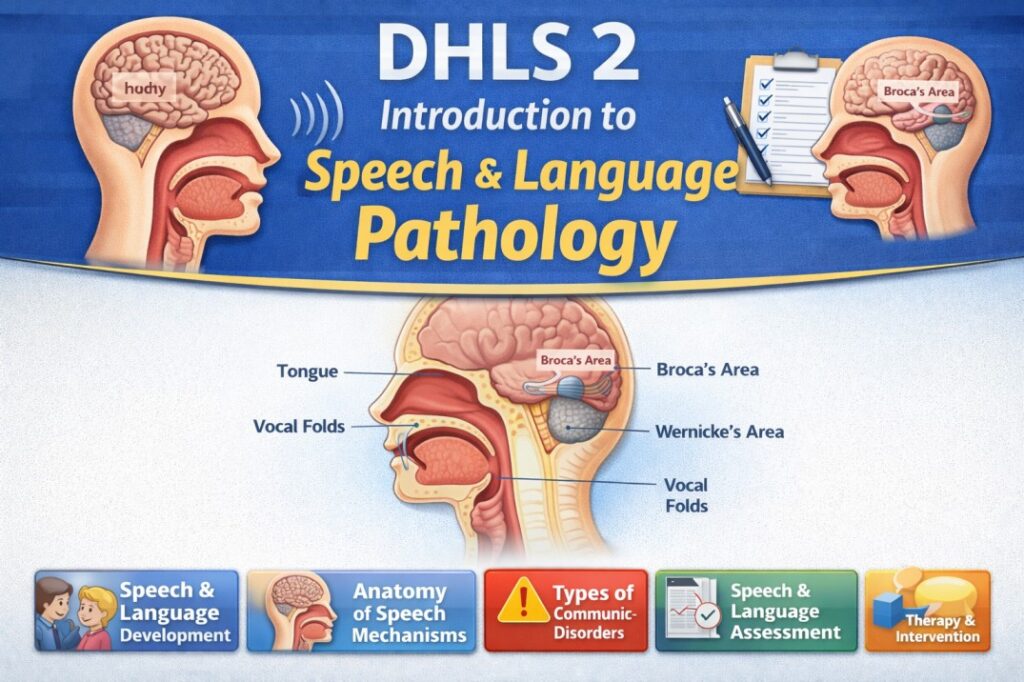
- Neurological Integrity: To process language in the brain (Broca’s and Wernicke’s areas).
- Oral-Motor Coordination: To physically move the articulators (tongue, lips, jaw).
- Social Interaction: A “language-rich” environment where caregivers talk to and respond to the child.
Prerequisites for normal speech and language development
Biological & Physiological Prerequisites
A developing child requires structurally and functionally intact physical systems to receive, process, and produce language.
- Intact Auditory System: Normal hearing is the primary gateway for language acquisition. A child must be able to perceive acoustic differences in speech sounds (phonemes) to replicate them.
- Neurological Integrity: An intact central nervous system (CNS) is required to process linguistic information. This includes the maturation of specific brain regions like Wernicke’s area (comprehension) and Broca’s area (motor planning for speech).
- Intact Speech Mechanism (Oral Motor): Structural integrity and motor coordination of the articulators (lips, tongue, teeth, hard/soft palate, jaw) and the phonatory/respiratory systems (vocal folds, lungs, diaphragm) are necessary to produce clear speech sounds.
Cognitive Prerequisites
Language is fundamentally a cognitive task. Before a child can use words, they must develop specific underlying thought processes (often aligned with Piaget’s sensorimotor stages).
- Object Permanence: The understanding that objects continue to exist even when out of sight. This is crucial because words are symbols used to represent absent objects or concepts.
- Cause and Effect: The realization that an action produces a specific outcome. This translates to communication: “If I vocalize or gesture (cause), the adult will respond to my needs (effect).”
- Means-End Behavior: The ability to use a tool to achieve a goal. Eventually, the child learns that language is the most effective “tool” or “means” to an “end” (e.g., using the word “milk” to get a drink).
- Imitation (Motor and Vocal): The ability to observe and copy the actions and sounds of others. Motor imitation (clapping) usually precedes vocal imitation (babbling and echoing words).
- Memory and Attention: The capacity to sustain attention to a stimulus and the working memory required to store, recall, and map auditory words to their physical meanings.
Social & Pragmatic Prerequisites
Speech and language develop out of a primary need for social connection. A child must possess the drive to interact.
- Joint Attention: The ability of a child and a caregiver to focus on the same object or event simultaneously. This is the bedrock of vocabulary building (e.g., both looking at a dog while the adult says, “Look, a dog!”).
- Intent to Communicate: A clear desire to share information, request needs, or protest, initially shown through crying, reaching, or pointing before words emerge.
- Turn-Taking: Understanding the reciprocal, back-and-forth nature of interaction. This begins with non-verbal games (like peek-a-boo) and translates into conversational turn-taking.
- Eye Contact: Essential for reading facial expressions, monitoring adult reactions, and establishing a shared social loop.
Environmental Prerequisites
Even with intact physical and cognitive systems, language will not develop in a vacuum.
Play Opportunities: Play is the primary context for early learning. Symbolic play (e.g., using a block as a phone) directly parallels the symbolic nature of language.
Rich Language Exposure: A language-rich environment where the child hears consistent, varied, and contextually relevant vocabulary.
Responsive Caregiving: Adults who actively acknowledge, interpret, and respond to a child’s early communicative attempts (coos, babbles, gestures), thereby reinforcing the value of communication.
Stages of development of speech in children with hearing impairment
Important Context: The Impact of Early Intervention
The trajectory of speech development in children with hearing impairment (HI) is heavily dependent on the age of detection and the timeline of audiological intervention (hearing aids or cochlear implants). Children aided early (before 6 months) may follow a timeline much closer to their typical peers.
The Pre-Linguistic Stage (0–6 Months)
In the first few months, the vocalizations of infants with HI are remarkably similar to those of hearing infants, as early sound production is primarily biological rather than auditory-driven.
- Characteristics:
- Produce normal reflexive and vegetative sounds (crying, burping, coughing).
- Begin cooing and producing vowel-like sounds around 2–3 months.
- The Divergence Point: Around 5–6 months, the quantity and quality of vocalizations begin to decrease compared to hearing peers due to the lack of auditory feedback (they cannot hear themselves or others).
- Practical Intervention:
- Prioritize visual and tactile engagement (face-to-face interaction, exaggerated facial expressions).
- Respond immediately to all vocalizations to reinforce the intent to communicate, even without auditory feedback.
The Babbling Stage (6–12 Months)
This is the stage where the gap in speech development becomes clinically evident.
- Characteristics:
- Delayed or Absent Canonical Babbling: The repetitive consonant-vowel combinations (e.g., “ba-ba-ba”) are significantly delayed, reduced, or completely absent.
- Vocalizations may sound more guttural, with restricted consonant variety (often relying on easily visible sounds like /b/, /p/, /m/).
- Reduced use of vocal play and jargon (conversational babbling with adult-like intonation).
- Practical Intervention:
- Introduce early amplification (if applicable/chosen by the family).
- Implement multimodal communication strategies (pairing vocalizations with natural gestures or formal signs).
- Encourage vocal imitation through tactile feedback (e.g., letting the child feel the vibration of the throat or the breath stream on the hand).
The Single Word (Holophrastic) Stage (1–2 Years)
The emergence of meaningful, expressive vocabulary is typically delayed.
- Characteristics:
- First words may appear much later than the typical 10–14 month window.
- Vocabulary acquisition is slower. The child may rely heavily on pointing and gesturing.
- Words produced often feature phonological processes like consonant deletion (especially ending consonants, which are harder to hear) or substitutions.
- Practical Intervention:
- Create a “visually rich” language environment. Label objects clearly and consistently while ensuring the child has a clear view of the speaker’s mouth.
- Utilize acoustic highlighting (emphasizing specific keywords using pitch or slight pauses) if the child is aided.
The Early Phrase and Sentence Stage (2–4 Years)
As the child attempts to string words together, syntactic and morphological challenges become prominent.
- Characteristics:
- Morphological Omissions: High-frequency, low-intensity speech sounds (like /s/ for plurals or possessives, and /t/ or /d/ for past tense) are frequently missed because they are often inaudible to a child with sensorineural hearing loss.
- Sentences are often shorter and structurally simpler (telegraphic speech persists longer).
- Voice quality issues may emerge (e.g., hypernasality, inappropriate pitch or volume control) due to poor self-monitoring.
- Practical Intervention:
- Explicitly teach morphological markers. Use visual cues (like written letters or specific hand signs) to represent plural ‘s’ or past tense ‘ed’.
- Use language expansion and extension: When the child uses a broken phrase, repeat it back with the correct grammatical structure without directly reprimanding.
Complex Language and Pragmatics (4 Years & Beyond)
In the preschool and early school years, the focus shifts to vocabulary depth, complex grammar, and social communication.
Utilize visual graphic organizers to help structure complex sentences and narratives.
Characteristics:
Difficulty acquiring abstract vocabulary, idioms, and multiple-meaning words.
Challenges with complex syntactic structures (passive voice, embedded clauses).
Pragmatic difficulties may arise, such as struggling to initiate conversations, maintain topics, or repair communication breakdowns, largely due to missing subtle auditory social cues (like tone of voice or sarcasm).
Practical Intervention:
Pre-teach vocabulary and core concepts before introducing them in a larger classroom setting.
Role-play social scenarios to explicitly practice pragmatic skills (turn-taking, asking for clarification).
Factors influencing development of speech in children with hearing impairment
Audiological Factors (The Physical Hearing Profile)
The nature and severity of the hearing loss provide the baseline for what acoustic information the child can naturally access.
- Degree of Hearing Loss: Children with mild-to-moderate loss have greater access to the acoustic features of speech (especially vowels and voiced consonants) than those with severe-to-profound loss, directly impacting spontaneous speech acquisition.
- Age of Onset:
- Pre-lingual: Hearing loss occurring before speech/language develops (typically before age 2). This presents the greatest challenge, as the child has no auditory memory of speech.
- Post-lingual: Hearing loss occurring after language foundations are laid. These children retain an auditory memory and neurological foundation, usually resulting in better speech intelligibility.
- Type of Hearing Loss: Sensorineural loss involves inner ear/nerve damage and often causes distortion of sound, not just a reduction in volume. Conductive loss (outer/middle ear) generally only reduces volume and is often medically treatable or fluctuates.
- Configuration of Loss: A “high-frequency” hearing loss specifically limits access to crucial speech sounds like /s/, /f/, /th/, and /sh/, leading to specific morphological and articulation deficits.
Intervention and Amplification Factors
The timing and quality of medical and technological intervention are the strongest predictors of outcomes.
- Age of Identification and Intervention: Following the “1-3-6 rule” (screen by 1 month, diagnose by 3 months, intervene by 6 months) maximizes the critical neurological window for language learning. Early aided children often perform on par with hearing peers.
- Type and Quality of Amplification: Access to appropriate technology (digital hearing aids, cochlear implants, or bone-anchored hearing systems) tailored to the child’s specific audiogram.
- Consistent Use of Devices: Devices only work when worn. The number of hours a child wears their amplification per day (often referred to as “eyes open, ears on”) correlates directly with vocabulary and speech clarity.
- Efficacy of Acoustic Mapping: Regular audiologic follow-ups to ensure hearing aids are perfectly tuned or cochlear implant maps are optimized as the child grows.
Environmental and Social Factors
Speech development relies heavily on the ecosystem surrounding the child, requiring a collaborative approach between home and school.
- Parental Involvement and Acceptance: Families who actively participate in early intervention sessions, accept the diagnosis, and consistently integrate language strategies into daily routines see the highest success rates.
- Quantity and Quality of Language Exposure: A language-rich environment where adults use strategies like acoustic highlighting, recasting, and parallel talk.
- Socioeconomic Status (SES): SES can unfortunately dictate access to early screening, high-quality amplification, continuous speech therapy, and transportation to specialized centers.
- The Acoustic Environment: Background noise is disproportionately detrimental to children with hearing aids/implants. Rooms with high reverberation (echoes) or constant background noise severely limit speech perception.
Child-Specific (Intrinsic) Factors
Every child brings their own unique neurological and cognitive profile to the learning process.
- Cognitive Abilities: Intact cognitive skills (memory, processing speed, problem-solving) facilitate faster language mapping and vocabulary acquisition.
- Presence of Additional Disabilities: A significant percentage of children with hearing impairment have co-occurring conditions (e.g., visual impairment, autism spectrum disorder, cerebral palsy, or specific learning disabilities) which complicate the diagnostic picture and require highly multidisciplinary interventions.
- Internal Motivation and Temperament: A child’s natural desire to communicate socially and their resilience in the face of communication breakdowns play a major role in their practical pragmatic development.
Educational and Pedagogical Factors
The structured learning environment and the capacity of the educators significantly shape long-term outcomes.
Peer Interactions: Regular social interaction with both hearing peers (providing typical language models) and peers with hearing impairment (providing shared identity and communication comfort).
Communication Mode Selected: Whether the family and school utilize an Auditory-Verbal approach (listening and spoken language strictly), Total Communication (speech combined with sign/gestures), or Bilingual-Bicultural (using regional Sign Language as L1 and written/spoken regional language as L2). Consistency in this approach is vital.
Inclusive Classroom Practices: An environment where teachers are trained to use FM/DM systems, face the student when speaking, utilize visual aids, and manage classroom acoustics directly impacts the child’s ability to engage with the curriculum and peers.
Language development in pre and post lingual children with hearing impairment
Defining the Baseline
- Pre-lingual Hearing Impairment: Hearing loss occurs before the foundational acquisition of spoken language (typically from birth to 2 years of age). The child has no established auditory memory or neurological blueprint for spoken words.
- Post-lingual Hearing Impairment: Hearing loss occurs after the child has successfully established a foundational grasp of spoken language (typically after age 2, often ages 4-5+). The child possesses an auditory memory and pre-existing neural pathways for syntax, vocabulary, and phonology.
Pre-lingual Language Development Profile
Because language must be built without a pre-existing auditory blueprint, development requires intense, explicit instruction rather than natural acquisition.
- Vocabulary (Semantics):
- Acquisition is significantly delayed. First words emerge much later.
- Vocabulary grows linearly rather than exponentially (missing the typical “vocabulary spurt” seen around 18 months).
- High reliance on concrete nouns and action verbs; profound difficulty with abstract concepts (e.g., “jealous,” “tomorrow”) and function words (e.g., “is,” “the”).
- Grammar & Sentence Structure (Syntax/Morphology):
- Persistent use of telegraphic speech (short, broken phrases like “Boy run”).
- Consistent omission of crucial grammatical markers that are acoustically soft (plural s, past tense ed, possessives).
- Difficulty comprehending complex sentences, such as passive voice (“The ball was thrown by the boy” is often misunderstood as “The ball threw the boy”).
- Speech Intelligibility (Phonology):
- Without early intervention, speech is often highly unintelligible to unfamiliar listeners.
- Prosody (the rhythm, pitch, and intonation of speech) is often flat or uncontrolled, lacking natural inflection.
Targeted Intervention Activities for Pre-lingual Profiles:
- Milestone Mapping: Focus on foundational pre-linguistic skills first (joint attention, turn-taking, cause-and-effect toys) before expecting expressive vocabulary.
- Auditory-Verbal Mapping: When utilizing hearing aids or implants, explicitly teach the brain to attach meaning to new sounds using the “Listen, Point, Say” sequence.
- Visual Supports: Use objects of reference, daily schedules, and heavy modeling. Multimodal input is critical to establishing the initial concept that “things have names.”
Post-lingual Language Development Profile
The primary challenge here is not building the language foundation, but preserving it, adapting to altered auditory feedback, and continuing age-appropriate development.
- Vocabulary (Semantics):
- Existing vocabulary is generally retained.
- The rate of acquiring new vocabulary may slow down if the child cannot incidentally overhear conversations (incidental learning accounts for a massive percentage of typical vocabulary growth).
- Grammar & Sentence Structure (Syntax/Morphology):
- Pre-existing grammatical structures remain intact. The child understands the “rules” of language.
- Depending on the age of onset, they may miss out on higher-level syntactic development (like complex embedding or advanced pragmatic rules) if they are cut off from high-fidelity peer interactions.
- Speech Intelligibility (Phonology):
- Speech is initially completely normal.
- Over time, there may be a gradual deterioration in articulation (especially of high-frequency consonants like /s/, /sh/) and vocal quality (volume control, pitch) due to the loss of auditory self-monitoring.
Targeted Intervention Activities for Post-lingual Profiles:
- Auditory Rehabilitation (Post-Implant/Aid): Focus on re-training the brain to map the new electronic sound from a device to the child’s existing auditory memory (e.g., “The robotic sound you hear now is the word ‘apple’ you already know”).
- Speech Conservation: Regular phonetic exercises and reading aloud to maintain articulatory precision and monitor vocal volume, preventing the deterioration of known speech sounds.
- Social-Pragmatic Bridging: Role-play activities to teach the child how to advocate for themselves in noisy inclusive classrooms (e.g., teaching them to say, “I missed that instruction, can you repeat it?”).