Table of Contents
ToggleDefinition of speech characteristics of normal speech and functions of speech
Pre-Requisites for Speech Training
Before a child can produce speech, the following environmental and physiological conditions must be met:
- Optimal Amplification: Consistent use of well-fitted hearing aids or cochlear implants.
- Acoustic Environment: Minimizing “Signal-to-Noise Ratio” (SNR) by reducing background noise (fans, outside traffic) and using soft furnishings to prevent echoes.
- Detection vs. Discrimination: The child must first detect a sound (know it’s there) before they can discriminate (tell the difference between “ba” and “pa”).
Components of Speech to be Addressed
Speech training is divided into three critical layers:
1. Suprasegmental Features (The “Melody”)
These are often the most affected in children with HI. Training includes:
- Breath Control: Teaching the child to sustain airflow to speak full sentences.
- Intensity: Controlling volume (not whispering or shouting).
- Pitch & Intonation: Avoiding “monotone” speech by practicing rising and falling tones.
- Duration/Rhythm: Understanding the timing of sounds and pauses between words.
2. Segmental Features (The “Sounds”)
- Vowels: Usually taught first as they are louder and easier to hear. Focus on tongue position and lip rounding.
- Consonants: Organized by Place (where in the mouth), Manner (how air escapes), and Voicing (vibration of vocal cords).
Methods of Teaching Speech
| Method | Focus Area | Key Technique |
| Auditory Global Approach | Fluent Speech | Focuses on whole sentences and conversational context rather than isolated sounds. |
| Multisensory Syllabic Unit | Phonetic Accuracy | Uses “Look, Listen, and Feel” to teach individual syllables ($CV$ or $CVC$ patterns). |
| Association Method | Literacy Link | Connects the spoken sound directly to the written letter/symbol from the start. |
Specialized Instructional Strategies
A. Visual & Tactile Aids
- Mirrors: Allowing the child to compare their mouth movements with the teacher’s.
- Tactile Feedback: Placing the child’s hand on the teacher’s chest (for resonance), throat (for voicing), or in front of the mouth (for breath/plosives).
- Visual Phonics: Using hand signs that represent the movement of the tongue or teeth for specific sounds.
B. The Auditory Sandwich
A three-step technique to strengthen the auditory pathway:
- Listen: Teacher says the word/sound without visual cues.
- Look & Listen: Teacher repeats it while the child watches the mouth.
- Listen: Teacher repeats it one last time without visual cues to “lock in” the sound.
C. Acoustic Highlighting
Changing the way you speak to make specific sounds stand out:
- Whispering a voiced sound to emphasize the “aspiration.”
- Elongating a target sound (e.g., “ssssss-un”).
- Pausing right before the target word to create anticipation.
Common Error Patterns (The “HI Speech Profile”)
Omissions: Dropping the final consonants of words (e.g., “ca” for “cat”).
Substitutions: Replacing hard-to-hear sounds with visible ones (e.g., /b/ for /v/).
Nasality: Too much or too little air escaping through the nose.
Neutralization: All vowels sounding like a generic “uh” sound.
Professional Best Practices
Follow the Developmental Sequence: Teach sounds in the order a typically developing child would learn them (e.g., /p, b, m/ before /r, l, th/).
Functional Vocabulary: Prioritize words the child needs daily (names, “water,” “help,” “no”).
Positive Reinforcement: Speech is physically exhausting for children with HI; focus on the effort of communication as much as the accuracy.
Parameters of speech
Suprasegmental Parameters (The “Prosody”)
Suprasegmentals are the features that span across syllables, words, and sentences. They provide the “emotional” and “rhythmic” context of speech.
- Pitch (Frequency):
- The perceived highness or lowness of the voice.
- Issue in HI: Often characterized by high-pitched or falsetto quality due to lack of auditory feedback.
- Intensity (Loudness):
- The volume or “power” behind the speech signal.
- Issue in HI: Difficulty regulating volume; speech may be too soft (if the child is shy) or too loud (shouting to hear themselves).
- Duration (Timing/Rate):
- The length of individual sounds and the overall speed of speaking.
- Issue in HI: Speech is often slower with inappropriate pauses between syllables.
- Intonation:
- The variation of pitch over a sentence (e.g., rising pitch at the end of a question).
- Issue in HI: “Flat” or robotic-sounding speech.
- Stress:
- Emphasis placed on specific syllables or words to change meaning (e.g., re-cord vs. re-cord).
Segmental Parameters (Phonetic Level)
These focus on the production of individual speech sounds (phonemes).
A. Vowels
Vowels are the “power” of speech. They are produced with an open vocal tract and are characterized by:
- Tongue Position: High/Low and Front/Back.
- Lip Configuration: Rounded vs. Unrounded.
- Jaw Opening: The degree of vertical space.
B. Consonants
Consonants provide the “clarity” of speech. They are classified by three main parameters:
- Place of Articulation: Where the breath is obstructed (e.g., Bilabial/Lips, Alveolar/Behind teeth, Velar/Back of throat).
- Manner of Articulation: How the breath is obstructed (e.g., Stops like /p/, Fricatives like /s/, Nasals like /m/).
- Voicing: Whether the vocal cords vibrate (Voiced /b/) or stay still (Voiceless /p/).
Secondary Parameters (Quality & Resonance)
These parameters affect the “color” and “clarity” of the voice:
- Resonance:
- The balance of sound between the oral and nasal cavities.
- HI Concern: Hypernasality (too much air through the nose) or Hyponasality (muffled, as if having a cold).
- Vocal Quality:
- The “texture” of the voice (e.g., breathy, hoarse, or harsh).
- Articulatory Precision:
- The accuracy with which the tongue and lips hit their targets. In hearing impairment, “vowel neutralization” (all vowels sounding like “uh”) is a common parameter to address.
Summary Table: The “Speech Chain”
| Parameter | Physical Property | Auditory Perception |
| Frequency | Vibration rate of vocal folds | Pitch |
| Amplitude | Breath pressure/Energy | Loudness |
| Spectrum | Shape of the vocal tract | Quality/Vowel Identity |
| Time | Duration of the signal | Rhythm/Rate |
Mechanism of speech production – structure and function of Respiratory, Phonatory, Articulatory, Resonatory and Regulatory system
The Respiratory System (The Power Source)
The respiratory system provides the exhaled air (egressive airflow) necessary to vibrate the vocal folds.
- Key Structures: Lungs, Diaphragm, Rib cage, Trachea, and Intercostal muscles.
- Function:
- During speech, the inhalation phase is shortened and the exhalation phase is significantly lengthened.
- It regulates subglottal air pressure, which determines the loudness and intensity of speech.
- The diaphragm and intercostal muscles control the steady release of air to sustain long sentences.
The Phonatory System (The Sound Source)
Phonation is the process where the raw energy of airflow is converted into audible sound (voice).
- Key Structures: Larynx (Voice Box), Vocal Folds (Glottis), and Hyoid bone.
- Function:
- Vibration: As air passes through the constricted vocal folds, they vibrate rapidly (the Bernoulli Effect), creating a “buzz.”
- Pitch Control: The length and tension of the vocal folds determine the fundamental frequency or pitch.
- Voicing: The system determines if a sound is “voiced” (vocal folds vibrating, like /b/) or “voiceless” (vocal folds open, like /p/)
The Resonatory System (The Amplifier)
Resonance is the process by which the “buzz” created in the larynx is amplified and modified as it travels through the cavities above.
- Key Structures: Pharyngeal cavity (throat), Oral cavity (mouth), and Nasal cavity (nose).
- Function:
- It gives the voice its unique quality or “timbre.”
- Velopharyngeal Closure: The soft palate (velum) acts as a valve. When it is raised, air stays in the mouth (oral sounds like /a/). When it is lowered, air enters the nose (nasal sounds like /m, n, ng/).
The Articulatory System (The Modifier)
Articulation is the process of shaping the resonated air into specific, recognizable speech sounds (phonemes) through the movement of various structures.
- Key Structures:
- Active Articulators: Tongue (the most important), lower lip, and lower jaw (mandible).
- Passive Articulators: Teeth, alveolar ridge (the bump behind the teeth), and hard palate.
- Function:
- The articulators create obstructions or narrowings in the vocal tract.
- By changing the shape of the oral cavity, the tongue creates different “formants” that allow us to distinguish one vowel from another.
The Regulatory System (The Controller)
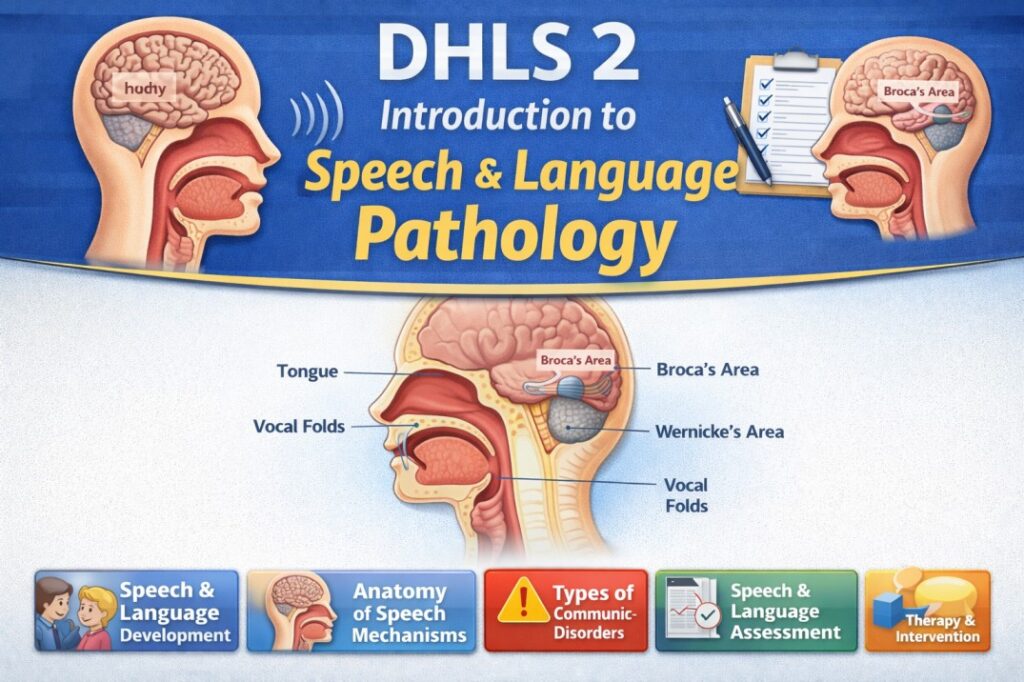
This is the “mastermind” that coordinates the other four systems. Speech is the most complex motor task the human body performs.
- Key Structures: Central Nervous System (Brain and Spinal Cord) and Peripheral Nervous System (Cranial nerves).
- Broca’s Area: Responsible for speech planning and motor programming.
- Wernicke’s Area: Responsible for language comprehension and selection.
- Motor Cortex: Sends the final electrical signals to the muscles.
- Function:
- Motor Planning: It sequences the movements of the tongue, lips, and larynx in milliseconds.
- Auditory Feedback: The brain monitors our own voice through the ears to make real-time corrections in pitch or volume.
- Tactile/Kinesthetic Feedback: It senses the position of the tongue and lips to ensure accuracy.
Speech as an overlaid function
The Concept of Primary vs. Secondary Functions
The “speech mechanism” is a collection of organs that belong to the respiratory and digestive systems. If we stopped speaking, we would live; if these organs stopped their primary functions, we would die.
Comparison Table
| Organ/Structure | Primary (Biological) Function | Secondary (Overlaid) Function |
| Lungs | Exchange of oxygen and $CO_2$ (Breathing) | Providing air pressure for sound |
| Larynx | Valve to protect the airway (Prevents choking) | Phonation (Vocal fold vibration) |
| Tongue | Moving food (Bolus) and Swallowing | Articulation of vowels and consonants |
| Teeth | Mastication (Chewing food) | Cutting/Constricting air (e.g., /f/, /s/) |
| Lips | Sucking and sealing the oral cavity | Shaping sounds (e.g., /p/, /b/, /m/) |
| Soft Palate | Preventing food from entering the nose | Controlling nasal resonance |
Evidence of Speech as an Overlaid Function
Several physiological factors support the idea that speech is an “add-on” to our biological systems:
- Involuntary vs. Voluntary Control: Breathing for life is involuntary (controlled by the brainstem). Speech requires us to take conscious, voluntary control over the respiratory cycle.
- The Laryngeal Valve: The larynx’s original purpose is to act as a “sphincter.” It closes tightly to prevent food from entering the lungs and stays open for breathing. To speak, we must hold the vocal folds in a state of “partial tension” that is biologically unnecessary but acoustically vital.
- Neuro-plasticity: Large areas of the human motor cortex are dedicated to the tongue and lips specifically for speech, a specialization not found in other mammals who use the same organs only for eating.
Clinical Significance in Special Education
Understanding speech as an overlaid function is critical when working with children with speech or hearing impairments:
- Vegetative Functions First: If a child has difficulty with primary functions (like sucking, chewing, or swallowing), they will almost certainly struggle with speech. Speech therapy often begins by strengthening these “vegetative” movements.
- Coordination Complexity: Because speech “borrows” these systems, any physical stress (shortness of breath, illness, or neurological issues) will cause the body to prioritize the primary function (breathing) over the overlaid function (speech).
- Efficiency: Speech is an incredibly efficient use of energy. We use the same air we were going to exhale anyway to communicate, making it a “low-cost” evolutionary advantage.
Introduction to Speech and Language Disabilities
Defining the Difference: Speech vs. Language
To understand the disabilities, one must first distinguish between the two components:
- Speech: The physical act of producing sounds. It involves the precise coordination of oral-motor muscles, respiration, and phonation.
- Components: Articulation, Voice, and Fluency.
- Language: A symbolic, rule-governed system used to convey a message. It involves the mental processing of thoughts into words and sentences.
- Components: Phonology, Morphology, Syntax, Semantics, and Pragmatics.
Classification of Speech Disorders
Speech disorders occur when a person has difficulty producing speech sounds correctly or fluently, or has problems with their voice.
A. Articulation and Phonological Disorders
- Description: Difficulties in the motor production of speech sounds or the linguistic rules governing those sounds.
- Common Errors (SODA):
- Substitutions (e.g., “wabbit” for “rabbit”)
- Omissions (e.g., “at” for “hat”)
- Distortions (e.g., a lateral lisp)
- Additions (e.g., “dog-uh” for “dog”)
B. Fluency Disorders
- Stuttering: Interruptions in the flow of speech, such as repetitions (li-li-like), prolongations (ssss-un), or blocks (silent struggles).
- Cluttering: A rapid or irregular speaking rate that leads to breakdowns in clarity and rhythm.
C. Voice Disorders
- Issues with the pitch, loudness, or quality of the voice.
- Examples include chronic hoarseness, aphonia (loss of voice), or resonance issues (hypernasality).
Classification of Language Disorders
Language disorders involve problems with receiving, processing, and sending information.
- Receptive Language Disorder: Difficulty understanding what others say. The person may have trouble following directions or identifying objects.
- Expressive Language Disorder: Difficulty putting thoughts into words and sentences. The person may have a limited vocabulary or use incorrect grammar.
- Mixed Receptive-Expressive Disorder: Challenges in both understanding and producing language.
Common Causes and Etiology
Communication disabilities can be categorized based on their origin:
- Organic: Caused by an identifiable physical or neurological factor.
- Examples: Cleft lip/palate, Hearing Impairment, Cerebral Palsy, or Traumatic Brain Injury.
- Functional: No known physical cause; often related to environmental factors or learning patterns.
- Examples: Specific Language Impairment (SLI) or certain articulation delays.
- Developmental vs. Acquired:
- Developmental: Present from birth or early childhood (e.g., Autism-related communication delays).
- Acquired: Occurs after a period of normal development, often due to illness or injury (e.g., Aphasia following a stroke).
Impact on Development
A speech or language disability is rarely “just” a communication issue. It often impacts:
- Academic Achievement: Difficulty in reading, writing, and understanding classroom instructions.
- Social-Emotional Growth: Risk of social isolation, frustration, and low self-esteem due to the inability to connect with peers.
- Behavior: Children may “act out” or exhibit challenging behaviors as a substitute for the communication they cannot provide verbally.
The Role of Early Intervention
The “Critical Period” hypothesis suggests that the brain is most receptive to language learning before age 5.
- Screening: Early identification through developmental milestone checklists.
- Multidisciplinary Team: Intervention typically involves a Speech-Language Pathologist (SLP), Audiologist, Special Educator, and the family.
- AAC (Augmentative and Alternative Communication): For those with severe disabilities, tools like picture boards or speech-generating devices are used to provide a “voice.”