
Table of Contents
ToggleFill in the blanks:
- The ear is also known as the ______________ system.
- The ear is divided into ______________ main parts.
- The outer visible part of the ear is called the ______________ ear.
- The inner ear is connected to the ______________ nerve.
- The auditory nerve is the ______________ cranial nerve.
- The cell bodies of the auditory nerve are located in the ______________ ganglion.
- The sensory receptors for hearing are called ______________ cells.
- Sound signals first reach the ______________ nucleus in the brainstem.
- The final processing of sound occurs in the ______________ cortex.
- The auditory cortex is located in the ______________ lobe of the brain.
Answers:
- Auditory
- Three
- External
- Auditory
- 8th
- Spiral
- Hair
- Cochlear
- Auditory
- Temporal
Tick the correct answer:
1. The ear has how many main parts?
a) Two
b) Three
c) Four
2. Which part of the ear is visible from outside?
a) Inner ear
b) Middle ear
c) Outer ear
3. The auditory nerve is also caled:
a) 5th cranial nervve
b) 8th cranial nerve
c) 10th cranial nerve
4. Which structure contains sensory hair cells?
a) Cochlea
b) Pinna
c) Eardrum
5. Where is sound finally understood?
a) Brainstem
b) Auditory cortex
c) Spinal cord
True or False
- The entire ear is visible from outside.
- The ear has three main parts.
- The auditory nerve carries signals from brain to ear.
- Hair cells are important for hearing.
- The auditory cortex is located in the temporal lobe.
Answers:
- False
- True
- False
- True
- True
Match the following:
| Column A | Column B |
| 1. Outer ear | a. Sound processing |
| 2. Inner ear | b. Hair cells |
| 3. Auditory nerve | c. Carries signals |
| 4. Cochlear nucleus | d. First brain center |
| 5. Auditory cortex | e. Visible part |
Answers:
1–e
2–b
3–c
4–d
5–a
Very short answer type questions:
- What is the auditory system?
- Name the three parts of the ear.
- What is the auditory nerve?
- Where are hair cells located?
- Where is the auditory cortex located?
Answers;
- It is the system responsible for hearing.
- Outer ear, middle ear, inner ear.
- It is the 8th cranial nerve that carries sound signals to the brain.
- In the inner ear (organ of Corti).
- In the temporal lobe of the brain.
Short answer type questions:
- Describe the parts of the human ear.
- What is the function of the auditory nerve?
- Explain the role of hair cells in hearing?
- What is the auditory nervous system?
- Name the pathway of sound in the brain.
Answers:
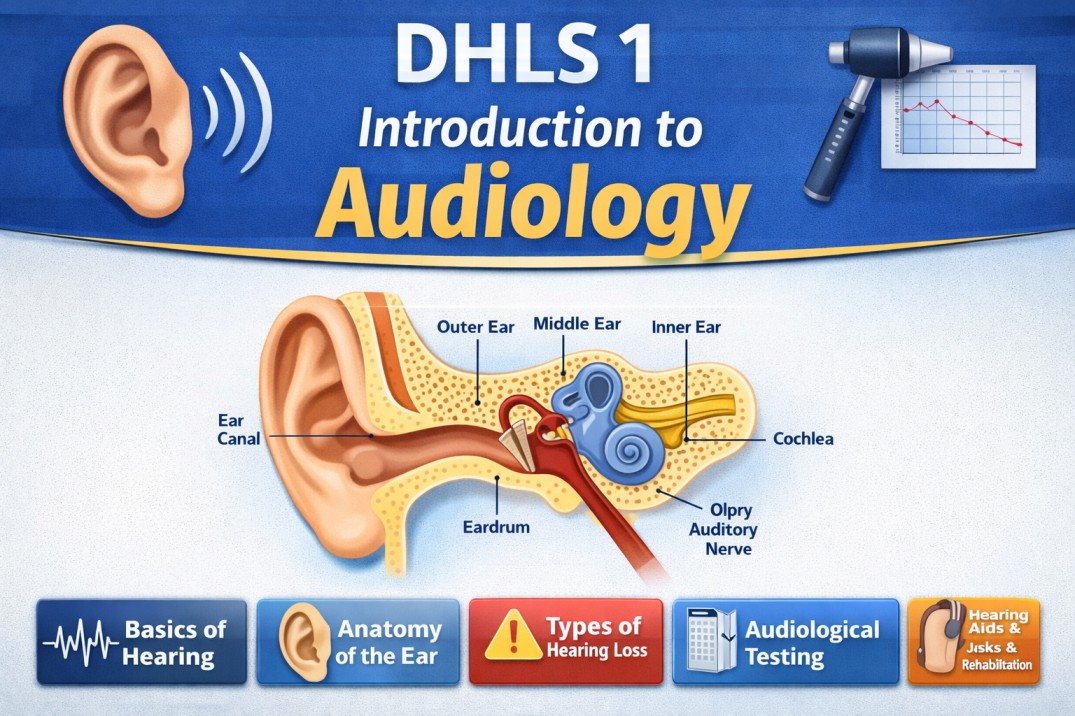
- The human ear has three parts: Outer ear: Collects sound, Middle ear: Transfers sound vibrations and Inner ear: Converts vibrations into nerve signals.
- The auditory nerve carries sound signals from the inner ear to the brain.
- Hair cells convert sound vibrations into electrical signals that can be sent to the brain.
- It is the system that carries sound information from the ear to the brain for understanding.
- Cochlear nucleus → Superior olivary complex → Inferior colliculus → Medial geniculate body → Auditory cortex.
Long answer type questions:
- Explain the structure of the human ear.
- Explain the auditory nervous system.
- Describe the pathway of sound from ear to brain.
- Explain the role of the inner ear in hearing.
- Explain the role of the brainstem in hearing.
- Explain how sound signals are transmitted from hair cells to the brain.
- Describe the importance of different auditory centers in the brain.
- Explain the step-by-step process of hearing.
Answers:
- The human ear is an important sense organ responsible for hearing. It is divided into three main parts: the outer ear, middle ear, and inner ear. The outer ear is the visible part that collects sound waves. The middle ear transfers these vibrations through tiny bones. The inner ear contains sensory hair cells that convert vibrations into electrical signals. These signals are then sent to the brain through the auditory nerve for interpretation.
- The auditory nervous system carries sound information from the ear to the brain. The auditory nerve (8th cranial nerve) plays a key role in this process. Its cell bodies are located in the spiral ganglion, and it connects to hair cells in the inner ear. The signals travel to the brainstem and pass through several centers such as the cochlear nucleus, superior olivary complex, lateral lemniscus, inferior colliculus, and medial geniculate body. Finally, the signals reach the auditory cortex, where sound is understood.
- Sound enters the ear and reaches the inner ear, where hair cells convert it into electrical signals. These signals are carried by the auditory nerve to the brainstem. From there, they pass through the cochlear nucleus, superior olivary complex, lateral lemniscus, inferior colliculus, and medial geniculate body. Finally, the signals reach the auditory cortex in the temporal lobe, where they are processed and understood.
- The inner ear plays a crucial role in the process of hearing. It contains the cochlea, which has sensory hair cells located in the organ of Corti. When sound vibrations reach the inner ear, these hair cells convert the mechanical vibrations into electrical signals. These electrical signals are then transmitted to the brain through the auditory nerve (8th cranial nerve). Thus, the inner ear is responsible for transforming sound vibrations into nerve impulses that can be understood by the brain.
- The brainstem plays an important role in processing sound signals received from the auditory nerve. The signals first reach the cochlear nucleus in the brainstem. From there, the information is transmitted to the superior olivary complex, which helps in locating the source of sound. The signals then travel through the lateral lemniscus to the inferior colliculus, which further processes auditory information. Thus, the brainstem acts as an important relay and processing center in the hearing pathway.
- Sound vibrations reaching the inner ear are detected by hair cells present in the organ of Corti. These hair cells convert mechanical vibrations into electrical signals. The dendrites of the auditory nerve connect with these hair cells and receive the signals. The signals then travel through the auditory nerve to the brainstem. From there, they pass through various centers such as the cochlear nucleus and inferior colliculus before reaching the auditory cortex, where they are interpreted.
- Different auditory centers in the brain play specific roles in processing sound. The cochlear nucleus is the first center that receives sound signals. The superior olivary complex helps in sound localization, allowing us to determine where the sound is coming from. The inferior colliculus processes and integrates auditory information. The medial geniculate body acts as a relay station, sending signals to the auditory cortex. Finally, the auditory cortex interprets the sound and gives it meaning.
- The process of hearing begins when sound waves enter the ear. These sound waves travel through the ear and reach the inner ear, where they are detected by hair cells. The hair cells convert sound vibrations into electrical signals. These signals are carried by the auditory nerve to the brainstem. From there, they pass through several auditory centers such as the cochlear nucleus, superior olivary complex, and inferior colliculus. Finally, the signals reach the auditory cortex in the temporal lobe, where they are processed and understood as meaningful sound.