Table of Contents
ToggleCommunication: Definition, Meaning and Scope
Meaning of Communication
The word “Communication” is derived from the Latin word ‘communis’, which means “common,” or ‘communicare’, which means “to share, to impart, or to transmit.”
- The Core Concept: Communication is not just the act of talking or making noise. It is the process of establishing a commonness or shared understanding between two or more people. If a message is sent but not understood by the receiver, communication has not occurred; only broadcasting has.
- Beyond Speech: Communication is a holistic process. It encompasses the exchange of facts, ideas, opinions, emotions, and attitudes through various channels, including spoken words, written text, sign language, facial expressions, and body language.
Definitions of Communication
For exam purposes, it is highly recommended to memorize a few standard definitions from recognized scholars:
- Edgar Dale: “Communication is the sharing of ideas and feelings in a mood of mutuality.” (This is an excellent definition for special education because it highlights the emotional and mutual connection).
- W.H. Newman and C.F. Summer: “Communication is an exchange of facts, ideas, opinions or emotions by two or more persons.”
- Peter Little: “Communication is the process by which information is transmitted between individuals and/or organizations so that an understanding response results.”
- The Clinical Distinction (Speech vs. Language vs. Communication):
- Speech: The physical motor act of producing sounds.
- Language: The cognitive rule system (grammar, vocabulary) used to structure thought.
- Communication: The overarching social act of exchanging those thoughts to influence others.
Nature and Characteristics of Communication
To truly grasp its scope, one must understand its inherent nature:
- A Two-Way Process: It requires a minimum of two parties: a Sender (who encodes the message) and a Receiver (who decodes the message and provides feedback).
- A Continuous Process: Human beings cannot not communicate. Even silence, a frown, or ignoring someone transmits a powerful message.
- Pervasive: It exists at all levels of human life—from a baby crying for milk to international diplomats negotiating treaties.
- Goal-Oriented: We communicate to achieve a specific outcome: to inform, to persuade, to express emotions, or to build relationships.
Scope of Communication
The “scope” refers to the range, extent, or sphere of action where communication is applied. The scope of communication is practically limitless, as it touches every dimension of human existence. It is generally categorized into the following spheres:
A. Personal and Intrapersonal Scope
- Intrapersonal Communication: Communication with oneself. This includes internal thought processes, self-reflection, planning, and maintaining a diary.
- Importance: It forms the foundation of self-concept and emotional regulation. For a child with hearing impairment, delays in inner language can impact this intrapersonal scope, affecting abstract thinking.
B. Interpersonal and Social Scope
- Interpersonal Communication: Face-to-face interaction between two or more people.
- Importance: This is the bedrock of human society. The scope here covers building friendships, navigating family dynamics, expressing empathy, and resolving conflicts. It dictates how we integrate into a community and understand societal norms.
C. Educational Scope
- Teaching and Learning: Education is entirely dependent on communication. The scope includes transferring knowledge from teacher to student, peer-to-peer collaborative learning, and the feedback loop of assessments.
- Special Education Application: This is where IEPs, Auditory-Verbal Therapy, and Indian Sign Language fall. The scope here is about dismantling barriers to ensure equal access to information and cognitive development.
D. Organizational and Professional Scope
- Workplace Dynamics: Within a business or organization, communication’s scope covers everything from downward instruction (a boss giving orders), upward feedback (employees reporting issues), to lateral collaboration (teamwork).
- Public Relations: How an organization communicates its identity to the outside world, consumers, and stakeholders.
E. Mass Communication Scope
- Broad Dissemination: Communicating a single message to a vast, anonymous audience simultaneously.
- Mediums: Television, radio, newspapers, social media, and the internet.
- Importance: It shapes public opinion, spreads cultural trends, and provides global news and entertainment.
Pedagogical Implication (For the Special Educator)
When a child is born with a severe hearing impairment, the entire scope of their communication is threatened.
- They are cut off from the Educational Scope (cannot hear the teacher).
- They struggle with the Social Scope (miss out on playground jokes and peer nuances).
- Ultimately, they face barriers in the Professional Scope (workplace underemployment).
The job of a special educator, audiologist, or speech therapist is to restore this scope. Whether through Cochlear Implants, Auditory Training, or Sign Language, the goal is never just to teach a child to say words—it is to give them full access to the boundless scope of human connection.
Classification of Communication: Linguistic and Non-linguistic
Communication can be broadly classified based on the symbols and channels used to transmit a message. For professionals in special education, this classification is vital because students—especially those on the Autism Spectrum or with hearing impairments—often process these two streams of information differently.
Linguistic Communication (Verbal Communication)
Linguistic communication relies on a structured system of symbols (words) and rules (grammar/syntax) to convey meaning. It is the most precise form of communication for sharing complex or abstract ideas.
A. Oral-Aural Communication (Spoken Language)
- Mechanism: Uses speech sounds (phonemes) produced by the vocal apparatus and received by the ear.
- Attributes: Includes vocabulary, grammar, and sentence structure.
- In Special Education: This is often the primary goal of Auditory-Verbal Therapy (AVT).
B. Written-Visual Communication (Written Language)
- Mechanism: Uses graphic symbols (letters, characters, Braille) to represent spoken language.
- Attributes: Allows for the preservation of information over time and distance.
- In Special Education: Essential for literacy and academic achievement. For students with ASD, written schedules or “Social Stories” provide a permanent visual reference that reduces anxiety.
C. Sign Language (Manual-Visual)
- Mechanism: Uses hand shapes, positions, movements, and facial expressions.
- Note: Sign Language (like ISL) is a fully linguistic system. It has its own unique grammar and syntax that is distinct from spoken language. It is not just “gesturing.”
Non-Linguistic Communication (Non-Verbal Communication)
Non-linguistic communication refers to all the ways we share meaning without using formal words. It is often spontaneous, continuous, and highly emotional. Research suggests that in face-to-face interaction, over 65–90% of the total impact of a message is non-linguistic.
A. Kinesics (Body Language)
- Gestures: Movements of the hands or arms (e.g., waving, pointing).
- Facial Expressions: The “window to the soul.” Expressions of joy, anger, fear, or sadness are largely universal.
- Posture and Gait: How a person sits, stands, or walks can signal confidence, defensiveness, or exhaustion.
B. Paralanguage (Vocalics)
- This refers to how something is said, rather than the words used.
- Attributes: Pitch, volume, rate of speech, intonation, and pauses.
- Example: Saying “Great job” with a sarcastic tone completely changes the linguistic meaning of the words.
C. Proxemics (Use of Space)
- How close we stand to someone communicates the nature of the relationship (Intimate, Personal, Social, or Public).
- Challenge: Students with social-communication difficulties may struggle to maintain appropriate “personal bubbles.”
D. Haptics (Touch)
- Communicating through physical contact (e.g., a handshake, a hug, or a pat on the back).
E. Eye Contact (Oculesics)
- Using gaze to signal interest, regulate turn-taking in conversation, or establish dominance.
The Interplay: Congruence vs. Incongruence
In effective communication, the linguistic and non-linguistic streams are congruent (they match). If you say “I am happy” while smiling, the message is clear.
If they are incongruent (e.g., saying “I’m fine” while crying), the receiver almost always believes the non-linguistic signal over the words.
Pedagogical Implication
For an educator or counselor, this classification is a diagnostic tool:
- Students with ASD: May excel at the linguistic level (vocabulary) but struggle to decode non-linguistic cues like sarcasm, eye contact, or “reading the room.”
- Students with Hearing Impairment: If they lack access to Paralanguage (tone and inflection), they may miss the emotional nuance of a teacher’s instruction.
- Visual Aids: When the linguistic stream is weak, we use non-linguistic supports (PECS, symbols, gestures) to build a bridge to understanding.
The Meaning Decoder
To understand how non-linguistic cues can completely override the literal meaning of words, use the simulator below. Change the “Non-Linguistic Tone” applied to a single phrase and observe how the interpreted meaning shifts for the listener.
Language: Definition, Characteristics and Functions
Meaning and Definitions of Language
Language is a highly complex, uniquely human, cognitive system. It allows us to encode our thoughts into a structured format that another person can decode and understand.
Standard Academic Definitions:
- Edward Sapir: “Language is a purely human and non-instinctive method of communicating ideas, emotions, and desires by means of a voluntarily produced system of symbols.”
- Noam Chomsky: “Language is a set (finite or infinite) of sentences, each finite in length and constructed out of a finite set of elements.”
- Henry Sweet: “Language is the expression of ideas by means of speech sounds combined into words.”
The Clinical Distinction (Crucial for Educators):
- Speech: The physical, motor production of sounds (articulation, voice, fluency).
- Language: The cognitive, rule-based system in the brain. It can be spoken, written, or signed. A child with physical cerebral palsy may have terrible speech but perfectly intact language.
- Communication: The social use of speech and language to interact with others.
Characteristics of Language
Linguists have identified several universal features that define human language and separate it from animal communication (like a dog barking or a bee dancing).
A. Language is Arbitrary There is no inherent or logical relationship between a specific word and the object it represents. There is no reason why a four-legged barking animal is called a “Dog” in English, “Kutta” in Hindi, or “Perro” in Spanish. The meaning is simply agreed upon by the society that uses it.
B. Language is Rule-Governed (Systematic) Language is not a random collection of words. It is governed by a strict hierarchy of rules across five domains:
- Phonology: The rules of sound organization (e.g., in English, words don’t start with “ng”).
- Morphology: The rules of word formation (e.g., adding “-ed” to make a past tense).
- Syntax: The rules of sentence structure/grammar (e.g., Subject-Verb-Object).
- Semantics: The rules of meaning and vocabulary.
- Pragmatics: The rules of social use (e.g., how to politely interrupt or take turns).
C. Language is Generative (Productive/Creative) Humans can produce and understand completely novel sentences that have never been spoken before in the history of the world. Because language relies on a finite set of rules, we can generate an infinite number of sentences.
D. Language has Displacement Animal communication is stuck in the “here and now” (a bird signals danger right now). Human language has displacement; it allows us to talk about things that are physically absent, events in the past, plans for the future, or entirely fictional concepts (like dragons or aliens).
E. Language is Culturally Transmitted While humans are born with a biological capacity for language (what Chomsky called the Language Acquisition Device), the specific language a child learns is entirely dependent on their environment. A child born to Chinese parents but raised in France will speak French, not Chinese. Language is learned through cultural exposure, not genetics.
F. Language is Dynamic Language is a living entity that constantly evolves. New words are added (e.g., “selfie,” “podcast”), old words die out, and grammatical rules slowly shift over generations.
Functions of Language (M.A.K. Halliday’s Taxonomy)
Why do children learn language? The linguist Michael Halliday identified seven core functions that motivate language development. For an educator, this is the ultimate checklist for assessing a child’s communication skills.
Basic Needs & Social Control
- Instrumental Function (“I want”): Using language to get needs met or acquire goods and services. (e.g., “Give me water,” “More milk”). This is often the very first function babies develop.
- Regulatory Function (“Do as I tell you”): Using language to control the behavior of others. (e.g., “Stop it,” “Put that down,” “Come here”).
Social Identity & Interaction
- Interactional Function (“Me and you”): Using language to establish and define social relationships. (e.g., “Hello,” “Let’s be friends,” “I love you”).
- Personal Function (“Here I am”): Using language to express individuality, personal feelings, opinions, and identity. (e.g., “I am a good boy,” “I hate spinach,” “I feel sad”).
Learning & Abstract Thought
- Heuristic Function (“Tell me why”): Using language to explore the environment, investigate reality, and learn about the world. This peaks in the toddler years with endless questions. (e.g., “Why is the sky blue?”, “What does this do?”).
- Imaginative Function (“Let’s pretend”): Using language to create imaginary environments, tell stories, or play make-believe. (e.g., “You be the monster and I’ll be the hero,” writing poetry).
- Informative / Representational Function (“I’ve got something to tell you”): Using language to communicate facts, exchange information, and report on events to someone who does not know the information. (e.g., “The capital of France is Paris,” “I went to the park yesterday”).
Pedagogical Implication (For the Special Educator)
Halliday’s Functions are critical for writing Individualized Educational Plans (IEPs).
When a child has a severe language delay (due to profound deafness or Autism Spectrum Disorder), they often get “stuck” using only the Instrumental and Regulatory functions. They learn to use words (or signs/PECS) just to demand food or stop an annoying sensory input.
A special educator’s job is to deliberately push the child’s language development into the higher-order functions. You must engineer situations that force the child to ask questions (Heuristic) or express their feelings (Personal) so they can fully access the academic curriculum and social world.
Phases of language developmental in typical children
The Pre-Linguistic Phase (Birth to 12 Months)
During this phase, the child is not using true words, but they are laying the neurological and physical groundwork for speech and communication.
- Phonation Stage (0–2 Months):
- Communication is reflexive. The infant produces vegetative sounds (burping, coughing, sneezing) and cries to express distress.
- Different cries begin to emerge for different needs (hunger vs. pain).
- Cooing and Gooing Stage (2–4 Months):
- The infant discovers their vocal cords.
- Produces vowel-like sounds (e.g., “ooo”, “ahhh”) and sometimes velar consonant sounds (like /k/ or /g/), typically when happy or content.
- Vocal Play / Expansion Stage (4–6 Months):
- The child experiments with their vocal tract, exploring pitch and volume. You will hear squeals, growls, yells, and “raspberries” (lip trills).
- Canonical (Reduplicated) Babbling (6–8 Months):
- A massive milestone. The infant begins combining consonants and vowels into repetitive strings.
- Examples: “ba-ba-ba-ba,” “ma-ma-ma-ma.” (Parents often mistake this for the child saying “Mama” or “Dada”, but at this stage, it lacks specific meaning).
- Variegated Babbling & Jargon (9–12 Months):
- Variegated: The consonant-vowel strings change within the sequence (e.g., “ba-da-ma-ga”).
- Jargon: The child babbles with the exact intonation, rhythm, and pauses of adult conversation. It sounds like they are speaking a foreign language. They also begin using intentional gestures (pointing, reaching).
The Single-Word (Holophrastic) Phase (12 to 18 Months)
The child transitions from meaningless sounds to true language with symbolic meaning.
- First True Words: Usually appear around 12 months. To be considered a “true word,” it must be used consistently to refer to a specific object or person, and it must sound somewhat similar to the adult word (e.g., “baba” for bottle).
- Holophrases: The child uses a single word to convey an entire sentence’s worth of meaning.
- Example: Pointing to a cookie and saying “Cookie” might mean “I want that cookie.” Pointing to a dropped cookie and saying “Cookie” might mean “My cookie fell.” The educator must rely heavily on context and non-linguistic cues (gestures, tone) to decode the meaning.
- Receptive Growth: While expressive vocabulary is around 10–50 words, receptive vocabulary (what they understand) is closer to 100–200 words. They can follow simple 1-step commands (“Give me the ball”).
The Two-Word (Telegraphic) Phase (18 to 24 Months)
This phase marks the onset of syntax (grammar).
- The Vocabulary Spurt: Around 18 months (or when the child reaches 50 single words), the brain experiences a “naming explosion.” The child begins acquiring new words at a rapid rate (up to 9 words a day).
- Word Combinations: The child starts combining two words to express semantic relations.
- Agent + Action: “Daddy go.”
- Action + Object: “Push truck.”
- Entity + Location: “Shoe on.”
- Possessor + Possession: “My cup.”
- Telegraphic Speech: The speech sounds like an old-fashioned telegram. They use the heavy-hitting content words (nouns and verbs) but strip away all the grammatical function words (articles, prepositions, auxiliary verbs). Example: “Mommy read book” instead of “Mommy is reading a book.”
The Early Sentence Phase (2 to 3 Years)
Language explodes from simple combinations to communicative sentences.
- Sentence Length: The child begins using 3- to 4-word sentences.
- Morphological Development: The child begins adding grammatical markers to their words. (Usually following Roger Brown’s Stages of Morphological Development).
- Present progressive -ing (“Running”)
- Plural -s (“Cats”)
- Prepositions in and on
- Question Formulation: The child starts asking “What?” and “Where?” questions, eventually moving into the exhausting “Why?” phase.
- Pragmatics: The child can hold brief conversations, take turns, and talk about things not currently in the room (Displacement). Intelligibility (how much a stranger can understand) reaches about 75%.
The Complex Sentence Phase (3 to 5 Years)
The child refines their language to sound nearly adult-like.
- Complex Syntax: They begin using conjunctions (and, because, but) to link ideas. Example: “I want to go outside because it’s sunny.”
- Narrative Skills: The child moves from just labeling objects to being able to tell a simple, sequential story with a beginning, middle, and end.
- Speech Clarity: By age 4, the child should be 100% intelligible to strangers, even if a few later-developing sounds (like /r/, /th/, /l/) are still slightly distorted.
- Metalinguistic Awareness: The child realizes that language itself is a tool. They start understanding rhyming, jokes, and puns.
Pedagogical Implication (For the Special Educator)
Understanding these phases is critical because intervention must follow developmental logic, not chronological age. If a 4-year-old student with Autism is currently non-verbal, you do not write an IEP goal for them to “speak in 4-word sentences.” You assess their current phase. If they are currently at the Pre-Linguistic level (using crying to communicate), your first goal is to teach them a Single Word or Pointing Gesture to request an item. You must build the staircase one step at a time.
Interactive Exploration: Language Development Timeline
To help memorize this sequence, use the interactive timeline simulator below. It allows you to explore how expressive language, receptive language, and grammar evolve simultaneously as the child ages.
Pre-requisites for language development &impact of deafness
Pre-requisites for Language Development (The Foundation)
Before a child can speak their first true word, three massive foundational systems must be intact and functioning.
A. Biological and Physiological Pre-requisites
The physical hardware of the child must be intact.
- Intact Sensory Organs: The child must have normal hearing to receive acoustic input and normal vision to read facial expressions and track objects.
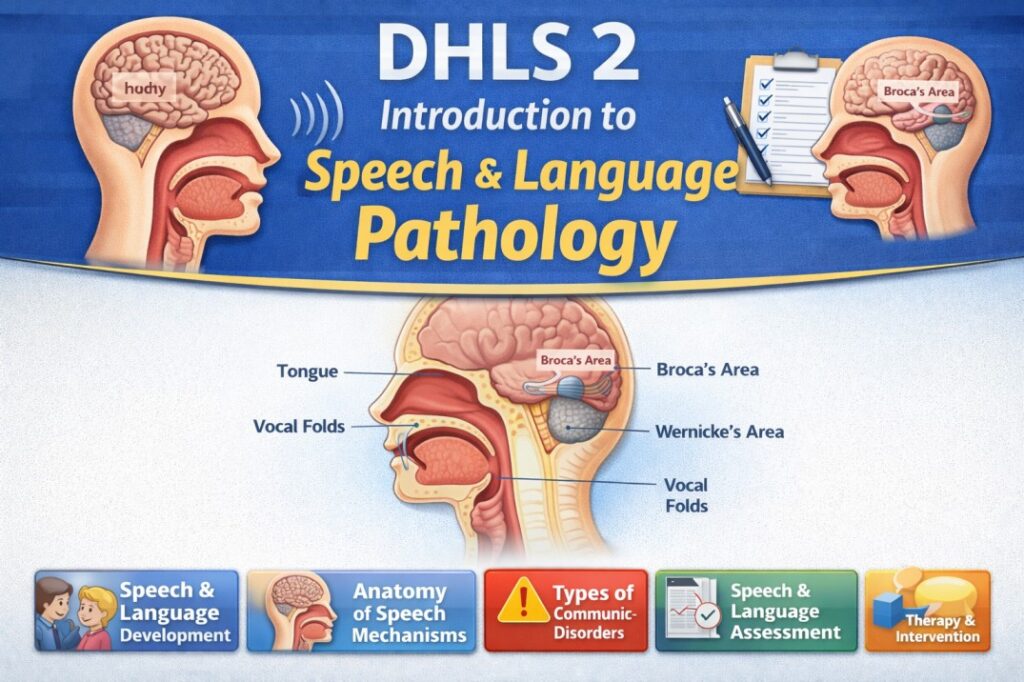
- Intact Neurological System: The brain must be healthy to process the input. Specifically, Wernicke’s area (for understanding language) and Broca’s area (for producing language) must be functional.
- Intact Speech Mechanism: The articulators (lips, teeth, tongue, palate) and respiratory system must possess the motor control to coordinate breathing and phonation.
B. Cognitive Pre-requisites (Mental Software)
A child cannot use a word to represent an idea if they do not yet have the cognitive capacity to hold that idea in their mind.
- Object Permanence: The understanding that an object still exists even when it is out of sight. (A child will not ask for “Milk” if they think the milk ceased to exist when the refrigerator door closed).
- Means-End Behavior: The understanding that one action causes another to achieve a goal. Language is the ultimate means-end tool (I say a word $\rightarrow$ I get what I want).
- Imitation and Memory: The cognitive ability to observe a sound or action, store it in working memory, and reproduce it later.
C. Social and Environmental Pre-requisites
Language is not learned in a vacuum; it requires a communicative partner.
- Joint Attention: The critical ability of the child and the caregiver to focus on the exact same object at the exact same time. If the mother says “Look at the dog!” but the baby is looking at a car, the baby will incorrectly map the word “dog” to the car.
- Turn-Taking: Understanding the back-and-forth rhythm of human interaction (even before words, through trading smiles or babbling).
- A Language-Rich Environment: The child must be bathed in meaningful, responsive language (often through “Motherese/Parentese,” which uses higher pitch and exaggerated intonation to capture the baby’s attention).
The Impact of Deafness on Language Development
Hearing loss is fundamentally an information block. It cuts off the biological pre-requisite of sensory input. Because the child’s brain is deprived of acoustic data, all four pillars of language (Phonology, Semantics, Syntax, and Pragmatics) suffer structural damage.
A. Impact on Phonology (Speech Sounds)
- The Problem: Children with hearing loss cannot hear the speech of others, nor can they monitor their own voice (auditory feedback loop).
- The Impact:
- They frequently omit high-frequency, low-energy consonants (like /s/, /sh/, /f/, /th/) because these sounds are invisible on the lips and soft to the ear.
- Vowels may be distorted or neutralized.
- Prosody Issues: Their speech may sound robotic, breathy, or lack the normal rising/falling melody (intonation) of natural language.
B. Impact on Semantics (Vocabulary)
- The Problem: Typical children learn 90% of their vocabulary through incidental learning (simply overhearing conversations in the next room, the TV, or adults talking at the grocery store). A deaf child only learns the words they are directly taught.
- The Impact:
- Vocabulary growth is significantly slower.
- They learn concrete words easily (cat, jump, red) but struggle massively with abstract words (think, jealous, tomorrow).
- They struggle with multiple-meaning words. (e.g., They know “bank” means a place with money, but fail to understand “sitting on the river bank”).
C. Impact on Syntax and Morphology (Grammar)
- The Problem: Grammatical markers in English (and many other languages) are carried by those exact same soft, high-frequency consonants that deaf children cannot hear.
- The Impact:
- They drop morphological markers: Plurals (“two cat”), past tense (“he walk yesterday”), and possessives (“Mom car”).
- They rely on rigid, simplistic sentence structures (Subject-Verb-Object).
- They struggle with complex syntax, such as passive voice. (“The boy was chased by the dog” is often misunderstood as “The boy chased the dog”).
D. Impact on Pragmatics (Social Use of Language)
- The Problem: Missing the “paralanguage” (tone of voice) and lacking the vocabulary to negotiate.
- The Impact:
- Difficulty entering a peer conversation appropriately.
- Frequently missing sarcasm, jokes, or subtle emotional cues, leading to social isolation.
- Because they cannot overhear the rules of social etiquette, they may seem overly blunt or fail to modulate their volume in quiet places.
Pedagogical Implication (For the Special Educator)
When you look at a student with unmitigated hearing loss, their language profile often looks identical to a student with an intellectual disability. It is not. Their cognitive foundation is perfectly healthy.
Your job is to bypass the biological roadblock. By providing early amplification (Cochlear Implants/Hearing aids) and direct, explicit instruction (AVT), or by bypassing the auditory channel entirely using visual language (Indian Sign Language), you restore the sensory input. Once the input flows, their healthy brain will build the language.
Interactive Exploration: The Language House Simulation
To fully understand the clinical impact of deafness, you must visualize how a single sensory deficit ripples upward, destroying the higher-level language structures.
Use the simulator below to change the child’s sensory status and observe how the pillars of language react to the loss of auditory input.