Table of Contents
ToggleFill in the blanks:
- __________________________ is defined as the verbal mode of communication produced using air from the lungs.
- The study of the internal structure of words and how meaningful units combine is called __________________________.
- __________________________ involves the appropriate use of language in different social situations and contexts.
- The smallest meaningful units of language are known as __________________________.
- __________________________ is a suprasegmental feature of speech that includes intonation, stress, and rhythm.
- The process of producing sound through the vibration of the vocal folds is called __________________________.
- A child typically begins __________________________ at approximately 6 months of age.
- __________________________ refers to the rules governing the arrangement of words to form meaningful sentences.
- __________________________ language refers to the ability to understand words and sounds.
- The normal rate of speech for an adult is approximately __________________________ words per minute.
Answers:
- Speech
- Morphology
- Pragmatics
- Morphemes
- Prosody
- Phonation
- Babbling
- Syntax
- Receptive
- 80-180 words
Tick the correct option:
1. Which component of language deals with the study of word meanings?
a) Phonology
b) Syntax
c) Semantics
d) Morphology
2. What is the “place of articulation” for the sound /p/?
a) Bilabial (both lips)
b) Velar (back of mouth)
c) Dental (teeth)
d) Alveolar
3. At what age does a child typically start using 2-word utterances?
a) 12 months
b) 18 months
c) 2 years
d) 3 years
4. Which of the following is a “voiced” sound?
a) /a/
b) /s/
c) /k/
d) /t/
5. The “Speech Chain” begins in the:
a) Larynx
b) Speaker’s brain
c) Listener’s ear
d) Vocal tract
6. Which theory suggests that language is an inborn or innate ability?
a) Nature hypothesis
b) Nurture hypothesis
c) Behaviorism
d) Cognitivism
7. Sounds like /m/ and /n/ are classified as:
a) Stops
b) Fricatives
c) Nasals
d) Affricates
8. What is the primary function of “Prosody” in speech?
a) To form words
b) To breathe properly
c) To add expression and meaning
d) To increase volume
9. A child who repeats exactly what they hear is exhibiting:
a) Jargon
b) Echolalia
c) Babbling
d) Cooing
10. Which is considered a “Secondary” mode of communication?
a) Speaking
b) Listening
c) Writing
d) Gesturing
Answers:
- Semantics
- Bilabial (both lips)
- 18 months
- /a/
- Speaker’s brain
- Nature hypothesis
- Nasals
- To add expression and meaning
- Echolalia
- Writing
True or False
- Language can exist without speech, but speech cannot exist without language.
- 0-6 month old infants can distinguish different voices and recognize sounds.
- Vowels are produced with significant obstruction in the oral tract.
- Stuttering is an example of a breakdown in speech fluency.
- Hearing is not essential for the natural development of speech.
- Pragmatics remains the same regardless of who you are talking to.
- “Nature” hypothesis supporters believe language is learned through imitation.
- A “Stop” consonant involves completely blocking the airflow before release.
- Reading and writing are primary modes of communication.
- Diphthongs are a combination of two vowel sounds.
Answers:
- True
- True
- False
- True
- False
- False
- False
- True
- False
- True
Very short answer type questions:
- Define speech.
- What are the three components of voice?
- What is ‘Intrapersonal communication’?
- What is a ‘Morpheme’?
- Name three articulators used in speech.
- What is ‘Voicing’?
- What does ‘Arbitrary’ mean in the context of language?
- At what age is a child’s speech approximately 80% intelligible?
- Define ‘Fluency’.
- What is the ‘Nature vs. Nurture’ debate?
Answers:
- Speech is the verbal mode of communication produced by vocal fold vibration and shaped by articulators.
- Pitch, Loudness, and Quality.
- Communication that occurs within an individual, such as thinking or reasoning.
- The smallest meaningful unit of language.
- The tongue, lips, teeth, and palate.
- Voicing is whether or not the vocal folds vibrate during the production of a sound.
- It means there is no natural or fixed connection between a word (symbol) and its meaning.
- By 3-4 years of age.
- The smooth, continuous, and effortless flow of speech.
- A debate over whether language is an inborn biological ability (nature) or learned from the environment (nurture).
Short answer type questions:
- Distinguish between Receptive and Expressive language.
- Briefly explain the “Speech Chain.”
- What is the difference between Pitch and Loudness?
- List four parameters of fluent speech.
- How are vowels and consonants different in terms of production?
- Describe ‘Pragmatics’ with an example.
- What are ‘Suprasegmental’ features?
- List three factors that can hinder language acquisition.
- Explain ‘Manner of Articulation’ with two examples.
- What are the prerequisites for effective communication?]
Answers:
- Receptive language is the understanding of words and sounds (listening/reading), while Expressive language is the use of speech, writing, or gestures to convey a message.\
- It is the process where a thought in the speaker’s brain is converted to language, produced as sound waves, received by the listener’s ear, and processed back into a thought by the listener’s brain.
- Pitch depends on the rate of vocal fold vibration (frequency), while Loudness depends on respiratory force or the amount of air used (intensity).
- Continuity (smooth flow), Rate (speed), Rhythm (pattern), and Effort (ease of speaking).
- Vowels are produced with an open oral tract and no obstruction, whereas consonants involve some form of obstruction or constriction in the oral tract.
- Pragmatics is the social use of language. An example is speaking formally to a teacher but using slang or casual language with a friend.
- These are features like intonation, stress, and rhythm that are superimposed on speech sounds to add meaning and emotion (collectively called Prosody).
- Inadequate stimulation, impaired hearing, and delayed general cognitive or physical development.
- It refers to how airflow is controlled. Examples include ‘Stops’ (complete blockage like /p/) and ‘Fricatives’ (narrow opening with friction like /s/).
- It requires a speaker (sender), a listener (receiver), a shared channel (language/speech), and functioning speech and hearing mechanisms.
Long answer type questions:
- Discuss the interrelation between Speech, Language, and Hearing.
- Describe the stages of language development from birth to 5 years, highlighting key milestones.
- Explain the five parameters of language (Phonology, Morphology, Syntax, Semantics, and Pragmatics).
- Discuss the various functions of communication in human life.
- Describe the speech production mechanism, specifically focusing on Voice and Articulation.
- Analyze the factors that affect or hinder the acquisition of speech and language.
- Explain the classification of speech sounds based on Voicing, Manner, and Place of Articulation.
Answers:
- Speech, language, and hearing are closely interconnected systems that depend on one another for functional communication. 1. Hearing as a Foundation: A child learns to speak primarily by listening to others. Hearing is essential for speech development because it allows an individual to perceive sounds and imitate them. Without proper hearing, a child cannot learn to speak naturally and may require special training. 2. Language and Speech Interdependence: Language provides the underlying meaning and concepts, while speech serves as the verbal expression of those concepts. 3. The Speech Chain: The text explains that communication begins in the speaker’s brain (thought), is converted into language, produced as speech, travels as sound waves, and is finally processed by the listener’s hearing system. For effective communication, both the speaker’s speech mechanisms and the listener’s hearing system must function properly.
- Language development occurs in gradual, predictable, and hierarchical stages. 1. Infancy (0–12 months): Communication begins with reflexive crying. By 6 weeks, babies begin cooing. At 6 months, babbling starts. By 8 months, they use intonational patterns, and at 1 year, they typically produce 1-word utterances. 2. Toddlerhood (18 months–2 years): Children reach the 2-word utterance stage at 18 months. By age 2, they begin using word inflections and have an expressive vocabulary of 50 to 100+ words. 3. Preschool (2.6–5 years): At 2.6 years, children begin using questions and negatives. By age 3, they use 3 to 4-word phrases and their speech is 50–75% intelligible. By age 4, they use 4 to 5-word sentences and their speech is 80% intelligible. By age 5, they use complex constructions and grammatically correct sentences of 4 to 8 words.
- Language is a socially shared system governed by five specific components: 1. Phonology: The study of speech sounds (phonemes) and the patterns used to combine them into meaningful words. 2. Morphology: The study of the internal structure of words and how morphemes (smallest meaningful units) combine to form words. 3. Syntax: The rules for how words are arranged and related to form meaningful, grammatical sentences. 4. Semantics: The study of the meaning of words and the arbitrary relationship between a symbol and the object it represents. 5. Pragmatics: The study of how language is used in social situations, including knowing what to say, how to say it, and when to say it based on context.
- The main function of communication is the transmission and exchange of information, but it serves several other vital roles: Knowledge: It is essential for the creation, preservation, and use of knowledge. Social Interaction: It allows for social behaviors like greeting others. Behavioral Control: It is used to influence others through persuasion, requests, or corrections. Expression of Needs: It allows individuals to express and satisfy their daily needs. Creativity: It serves imaginative and creative purposes.
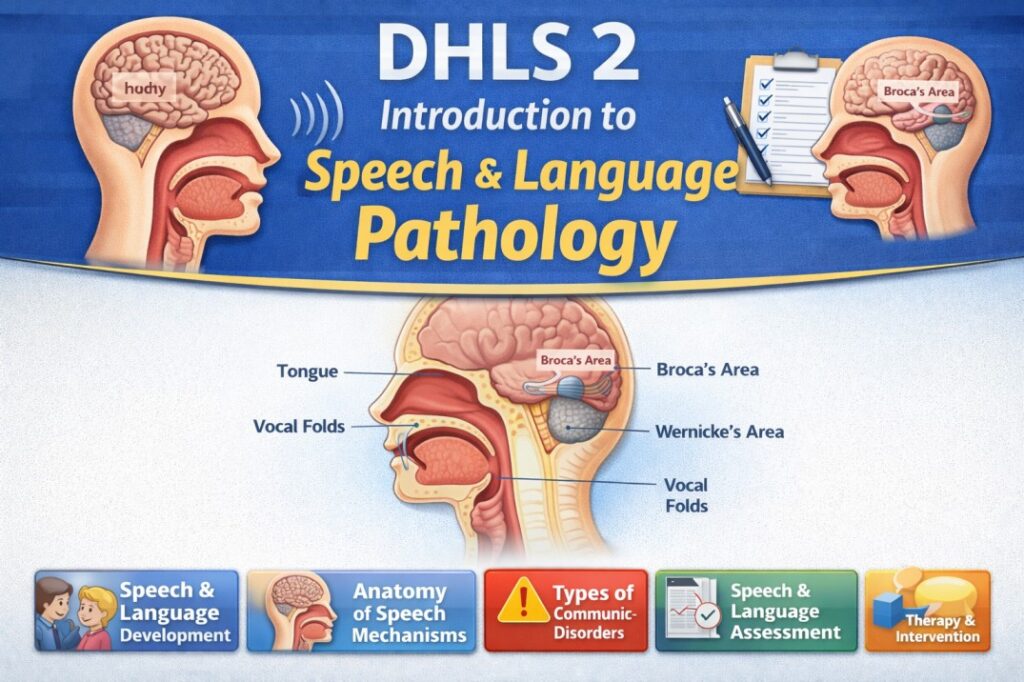
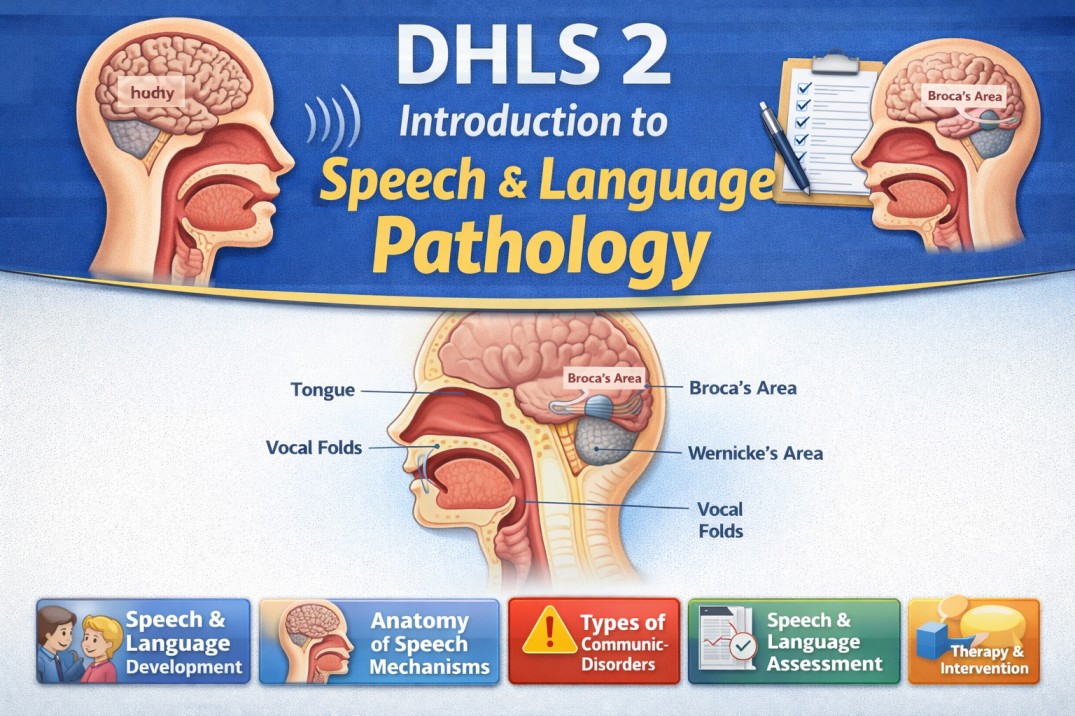
- Speech is a verbal mode of communication produced using expiratory air from the lungs. Voice (Phonation): Produced when air passes through the larynx, causing the vocal folds to vibrate. Voice is characterized by pitch (rate of vibration), loudness (respiratory force), and quality (character of the sound). Articulation: Refers to the movement of speech organs (articulators) like the tongue, lips, teeth, and palate. Articulation shapes the sound produced by the larynx into specific speech sounds through changes in the vocal tract.
- The passage lists several general factors that can obstruct the development of speech, language, and communication: Biological/Medical: Impaired hearing (e.g., ear infections), poor coordination of speech muscles, and global developmental delays. Environmental: Inadequate stimulation (lack of talking/playing), sudden exposure to too many languages, or moving to new environments. Psychological/Social: Short attention span, anxiety, or pressure to perform. Opportunity: Inadequate opportunity for speech (e.g., a dominant sibling or being “babied”).
- Speech sounds are systematically classified based on three main features: Voicing: Sounds are voiced if the vocal folds vibrate (e.g., /a/) and unvoiced if they do not (e.g., /s/, /p/). Manner of Articulation: How the airflow is controlled. This includes stops (complete blockage), fricatives (narrow constriction), nasals (air through the nose), affricates (stop with slow release), and glides. Place of Articulation: The specific location in the oral tract where the sound is formed, such as bilabial (both lips), dental (teeth), or velar (back of the mouth).