Hearing loss can occur due to a defect in any part of the ear or the auditory system, and there are many possible causes for it. However, not all individuals with hearing loss experience the same type or level of difficulty. The nature of hearing loss varies from person to person, and the problems faced by each individual may be different. In this unit, we learn about the different types of hearing loss, their effects, and the importance of identifying hearing loss at an early stage.
Table of Contents
ToggleNature of Hearing Loss
Hearing loss refers to the inability of a person to hear sounds properly. It can occur due to defects in any part of the ear or auditory system, and its nature and severity vary depending on the part affected. Hearing loss can be seen in both children and adults. For example, a child may not respond to their name or loud sounds, while an adult may not respond appropriately in conversations or to environmental sounds like a doorbell.
Hearing loss may be congenital (present from birth) or acquired later in life. It can develop suddenly or gradually, and in some cases, it may worsen over time (progressive), remain stable, or even fluctuate. The impact of hearing loss also differs among individuals—some may function normally despite the impairment, while others may face significant difficulties.
According to the World Health Organization (WHO, 1980), there are clear differences between impairment, disability, and handicap. Impairment refers to an abnormality in structure or function (such as a problem in the ear). Disability is the functional limitation caused by the impairment (such as difficulty in hearing or speaking). Handicap refers to the social consequences of the disability, such as isolation or difficulty in employment. Not all impairments lead to disability, and not all disabilities result in a handicap.
Thus, hearing loss can be defined as a partial or complete reduction in the ability to detect or understand sounds.
Causes of Hearing Loss
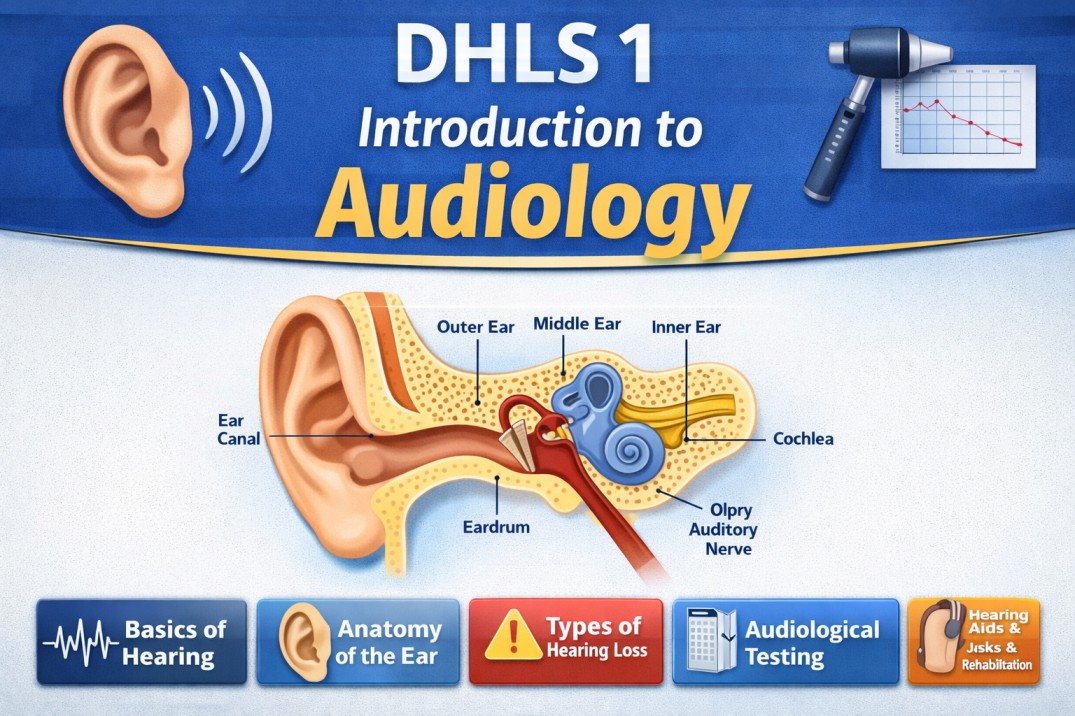
Hearing loss can occur due to various problems affecting different parts of the ear. Some causes are visible, such as discharging ears or absence of the pinna (outer ear), while others are not easily seen. Any issue in the external ear, middle ear, inner ear, or auditory nerve can lead to hearing loss. These causes are broadly classified based on the part of the ear affected—namely, external ear problems, middle ear problems, and inner ear problems. Understanding these causes helps in identifying and managing hearing loss effectively.
Causes of External Ear Problems
a) Congenital malformations: These are abnormalities present since birth. The common abnormalities seen are: i) Deformity of the pinna ii) Closure of the ear canal
b) Blockage of the ear canal due to i) Impacted wax ii) Foreign bodies iii) Tumours/growths
c) Infections of the external ear
Causes of External Ear Problems
a) Rupture or perforation of the eardrum
b) Infections of the middle ear
c) Ossicular abnormalities:
i) Congenital absence of one or more ossicles.
ii) Accidental fracture of one of the three ossicles.
iii) Improper connecting among the ossicles themselves.
iv) Fixation of one of the ossicles.
v) Fluid or any growth in the middle ear which disrupts the movement of the ossicles.
Cause of inner ear and the auditory nerve
a) Congenital malformation of the inner ear and/or auditory nerve.
b) Destruction of the hair cells of the cochlea due to: Aging, Trauma/injury, Noise, Drugs and Viral and bacterial infections.
c)Changes in the pressure of inner ear fluids.
d) Abnormalities in the blood supply to the cochlea.
e) Destruction of the nerve cells.
Hearing loss can occur due to two main types of causes:
a) Genetic Causes
Related to genes or chromosomes.
Can be inherited (passed from parents to children).
Individuals may have a family history of hearing loss.
A genetic counsellor can predict the chances of hearing loss in such cases.
b) Non-Genetic Causes
These are not inherited and can occur at different stages:
- Prenatal (Before Birth)
- Perinatal/Natal (During Birth)
- Postnatal (After Birth)
Prenatal Causes (Before Birth)
These occur when the baby is in the mother’s womb. First 3 months of pregnancy are very critical.
Poor maternal health
Lack of proper nutrition
Infections such as Rubella (German measles), Toxoplasmosis, Symphilis, Herpes, Cytomegalovirus
Exposure to X-rays or radiation
Side effects of certain medications
Perinatal/Natal Causes (During Birth)
These occur at the time of delivery.
Lack of oxygen (Birth asphyxia). Example: Baby doesn’t cry immediately after birth.
Improper medical care during delivery.
Low birth weight.
Baby on ventilator for more than 10 days.
Neonatal jaundice (within first 10 days).
Postnatal Causes (After Birth)
These occur after the child is born.
Diseases: Measles, Mumps, Meningitis (brain infection), Ear infections.
Side effects of medications
Head injury
Exposure to loud sounds/noise
Important points:
- Hearing loss can be preventable in many cases.
- Proper prenatal care is very important.
- Early medical care and awareness can reduce risks.
- Avoid infections, harmful drugs and loud noise exposure.
Different types of hearing loss
Hearing loss can be classified into different types depending on which part of the ear is affected. The ear is divided into three main parts external ear, middle ear, and inner ear and damage to any of these parts can result in hearing difficulties.
Conductive hearing loss occurs when there is a problem in the external ear and/or the middle ear. In this type of hearing loss, sound is not able to travel properly to the inner ear due to blockage or damage in these parts.
Sensorineural hearing loss occurs due to a problem in the inner ear. It is usually caused by damage to the sensory hair cells or the auditory nerve, which affects the transmission of sound signals to the brain.
Mixed hearing loss is a combination of both conductive and sensorineural hearing loss. In this case, there is damage in both the external or middle ear as well as the inner ear, leading to more complex hearing difficulties.
Another type of hearing-related difficulty is Auditory Processing Disorder (APD). In this condition, the ears may receive sound normally, but the brain has difficulty processing and understanding the sound. As a result, some individuals may respond when spoken to loudly, while others may not respond even to loud sounds.
The extent of hearing loss is not the same for all individuals. It varies from person to person and is categorized into different degrees of hearing loss. These degrees determine how much difficulty a person faces in communication, with more severe hearing loss leading to greater challenges in understanding speech and interacting effectively.
| Degree of hearing loss | Probable communication problems |
| Mild | Has difficulty hearing faint or distant speech |
| Moderate | Understands conversational speech only from a distance of 3-5 feet |
| Moderately severe | Conversation must be loud to be understood. There is great difficulty in group conversation. |
| Severe | May hear a loud voice about one foot from the ear, may identify environmental noises; may distinguish vowels but not consonants. |
| Profound | May hear loud sounds; does not rely on hearing as a primary channel for communication. |
Hearing loss in an individual can vary based on how it develops and changes over time. It may be progressive, sudden, or fluctuating in nature.
Progressive hearing loss is a type of hearing loss that gradually becomes worse over time. An individual may initially have mild difficulty in hearing, but the condition slowly increases in severity.
In contrast, sudden hearing loss occurs rapidly and within a short period. The individual may experience an immediate reduction in hearing ability, which can be alarming and requires prompt medical attention.
Another type is fluctuating hearing loss, in which the hearing ability changes over time. In such cases, the individual may sometimes hear better and at other times experience more difficulty, as the hearing levels keep varying.
The rehabilitation or treatment provided to an individual with hearing impairment depends on both the nature (type) and the extent (degree) of the hearing loss. Proper assessment is important to decide the most suitable management approach for improving communication and overall quality of life.
Effects of hearing loss
Hearing loss is often described as an invisible problem because, in most cases, it cannot be identified through a person’s physical appearance. An individual with hearing loss may look like anyone else, and there may be no visible signs indicating the condition. However, the effects and consequences of hearing loss are clearly noticeable, especially in communication and daily interactions.
Hearing loss can be challenging at any age, but it has a greater impact on infants and children. This is because early childhood is a crucial period for the development of speech, language, and communication skills. When hearing is affected during this stage, it can interfere with overall development.
It is important to understand that the problems faced by individuals with hearing loss are not the same for everyone. The difficulties vary depending on several factors. These include the type of hearing loss, the degree or severity of hearing loss, the age at which the hearing loss occurred, and the age at which rehabilitation or intervention was started.
Therefore, hearing loss affects individuals differently, and proper assessment and timely intervention are essential to reduce its impact and improve communication abilities.
Effects of hearing loss in children
Children with hearing loss since birth often develop speech and language problems, especially if the condition is not identified and treated early. Since they cannot hear speech clearly, they find it difficult to learn to speak. The severity of hearing loss plays an important role—children with severe to profound hearing loss may not develop speech without early rehabilitation, while those with mild or moderate hearing loss may speak but often have limited vocabulary and difficulty with grammar.
Hearing loss also affects academic performance, particularly in areas like reading and mathematics, leading to poor school achievement and limited career opportunities. In addition, it can cause psychological and behavioural problems, such as depression, anxiety, hyperactivity, aggression, or social isolation.
Overall, hearing loss significantly impacts a child’s quality of life and development. It mainly affects children in four ways: delay in communication skills, difficulty in learning, social and emotional problems, and reduced vocational opportunities later in life.
Effects of hearing loss in adults
The effects of hearing loss are generally less severe in adults and older individuals compared to children, but they still significantly impact daily life. As hearing ability decreases, effective communication becomes difficult, leading individuals to withdraw from social interactions. This can result in feelings of frustration, embarrassment, and discouragement, ultimately affecting their overall quality of life.
Hearing loss may also cause social isolation and negatively affect both personal and professional life. At the workplace, it can lead to reduced productivity and increased risk of accidents due to communication difficulties. Individuals with hearing loss often have trouble monitoring their own voice—those with conductive hearing loss may speak softly, while those with sensorineural hearing loss may speak loudly.
Many adults may not be aware of their hearing loss, but changes in their behaviour are often noticed by family and friends. Overall, hearing loss in adults leads to communication breakdown, speech difficulties, psychological stress, social and family problems, and reduced vocational efficiency.
Signs and symptoms of haring loss
There are several signs and symptoms of hearing loss. A few of the common ones, are listed below. The individual may:
- Ask for frequent repetition of message being spoken
- Ask for the message to be spoken louder
- Not respond when spoken to from the back
- Come closer, bending his/her head towards the speaker
- Cup his/her ear to hear well
- Have difficulty in following a conversation between two or three people, when they talk simultaneously
- Not understand speech well in a noisy situation
- Relies more on speech reading (lip reading)
- Give incorrect responses to a question
- Unclear speech
- Avoid participating in a conversation
- Increase the volume of a TV or radio to hear well
- The person may have problems in answering a telephone
- May have poor academic performance, if he/she is a child
- May be distracted, carrying out other activities while the classes are being conducted, if he/she is a child
Some other signs and symptoms that may occur are:
- Ringing sound in one or both the ears (tinnitus)
- Blocking sensation in the ear/ears
- Ear discharge
- Ear pain
- Giddiness
- Frequent attacks of cold
However, it is important to note that these signs and symptoms may also occur due to other conditions. Therefore, they should not be used for final diagnosis but only as indicators to suspect hearing loss and refer the individual for proper audiological evaluation.
Associated problems with a hearing loss
Hearing loss can lead to communication and psychological problems, especially in children, and is often accompanied by certain signs and symptoms such as tinnitus (ringing in the ears) and giddiness or dizziness. In many cases, the same factors that cause hearing loss may also lead to tinnitus, although its exact cause is not always known. Since the inner ear is responsible for both hearing and balance, damage to it can also result in balance problems. However, giddiness is not always due to inner ear (vestibular) issues and may occur due to other conditions as well.
Hearing loss may sometimes co-exist with other abnormalities, either due to the same cause (as seen in syndromes) or due to different reasons. A syndrome refers to a group of symptoms that occur together and indicate a particular condition. Individuals with hearing loss may also have associated conditions such as low vision or blindness, intellectual disability, cerebral palsy, or learning disorders.
The impact of hearing loss varies depending on these associated conditions, and accordingly, the methods of assessment and rehabilitation are also adjusted to meet the individual’s specific needs.