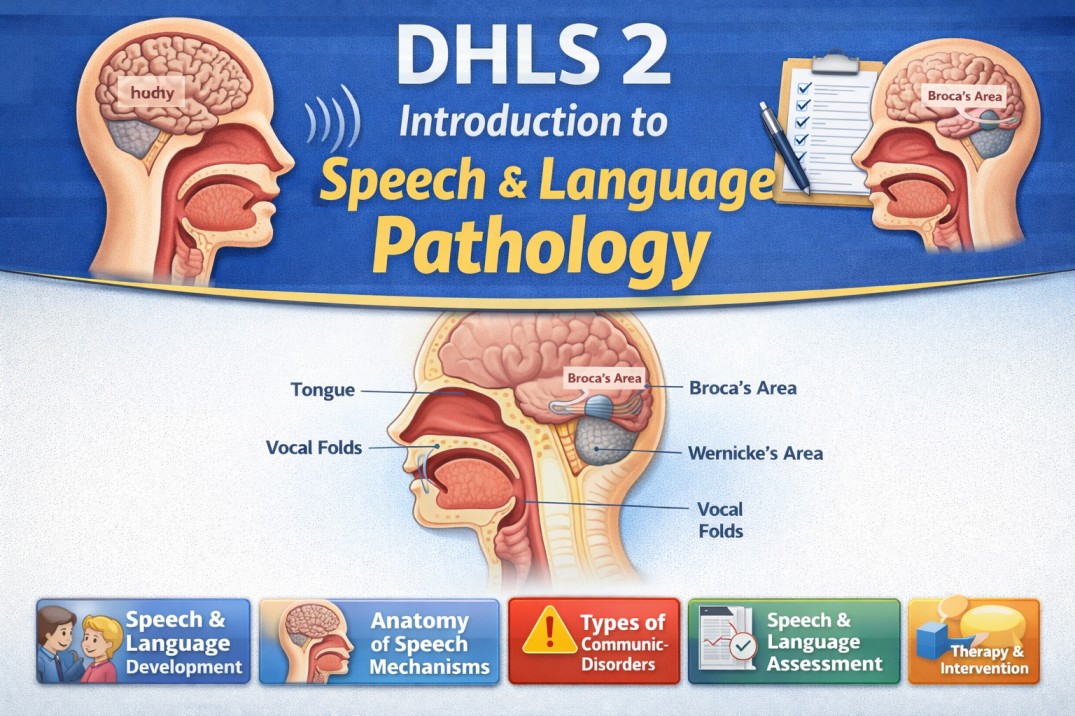
Speech-language pathologists (SLPs) play an essential role in supporting preschool and school-age children with spoken language disorders (SLD). Their responsibilities cover a wide range of professional activities, including clinical and educational services such as screening, assessment, diagnosis, planning, and treatment of language difficulties. In addition to direct intervention, SLPs are also involved in prevention and advocacy by promoting early identification and awareness of communication disorders. They further contribute through education, administration, and research, helping to improve practices and outcomes in the field of speech-language pathology.
A spoken language disorder (SLD), also known as an oral language disorder, refers to a significant difficulty in acquiring and using language across different modalities, including speech and sign language. This impairment may affect both comprehension and production and can involve one or more of the five key language domains: phonology (sound system), morphology (word formation), syntax (sentence structure), semantics (meaning), and pragmatics (social use of language). Language disorders often persist throughout a person’s life, although the nature and severity of symptoms may change over time.
When a spoken language disorder occurs as a primary condition and is not associated with other factors such as intellectual disability, global developmental delay, hearing or sensory impairments, motor dysfunction, or other medical or mental health conditions, it is classified as a specific language impairment (SLI). This distinction highlights that SLI is a standalone language difficulty rather than part of a broader developmental issue.
Table of Contents
ToggleTypes of language disorders
An SLD may also occurs in the presence of others conditions, such as
- Autism spectrum disorder (ASD)
- Intellectual disabilities (ID)
- Development disabilities (DD)
- Attention deficit hyperactivity disorder (ADHD)
- Traumatic brain injury (TBI)
- Psychological/Emotional disorders
- Hearing loss
Children from different affected groups may show varied behaviors, but they share common language difficulties. There is a strong connection between spoken and written language, as children with spoken language problems often struggle with reading and writing. Similarly, those with reading and writing difficulties may also face challenges in spoken language, especially in higher-order skills like organizing and explaining ideas (expository discourse). Some children with language disorders also experience social communication difficulties, since language processing, social interaction, social cognition, and pragmatics are all closely related.
Language disorders and learning disabilities (LD) are closely connected, although their exact relationship is still debated. Language disorders are usually identified earlier and can significantly affect a child’s academic performance. As a result, children may later be labeled as having a learning disability, even though underlying language difficulties are often the root cause, particularly in challenges related to reading and writing.
Objective of assessment
There are several goals in a diagnostic assessment depending on the set up and objectives of the same. These include:
- Verifying that a speech-language impairment exists
- Describing the strengths and challenges of the child’s speech and language
- Differential diagnosis
- Describe the nature of the individual with problem
- Describe co-morbidity of other disorders and conditions
- Determining the course of the problem
- Evaluating the severity of the problem
- Ascertaining the etiology
- Recommendations for treatment plan
- Providing prognosis
- Predicting severity
- Pre-post therapy comparison to check improvement
- Provide outcome measures for purchasers
- Research purpose
Screening
Screening of spoken language skills is conducted if a language disorder is suspected. Screening does not result in a diagnosis, but rather indicates the potential need for further assessment.
Screening typically includes
- gathering information from parents and/or teachers regarding concerns about the child’s languages and skills in each language
conducting a hearing screening to rule out hearing loss as a possible contributing factor to language difficulties - administering formal screening assessments that have normative data and/or cut off scores and demonstrated evidence of adequate sensitivity and specificity
- using informal measures, such as those designed by the clinician and tailored to the population being screened (e.g., preschool vs. school age/adolescence)
- screening of articulation if indicated
screening may result in recommendations for
- complete audiologic assessment
- comprehensive language assessment
- comprehensive speech sound assessment, if the child’s speech sound system is not appropriate for his/her age and/or linguistic community
Tools for assessment
Assessment of communication skills requires collecting samples across different settings using a variety of procedures. It is important to gather information not only through standardized, formal tools but also through authentic, real-life contexts to ensure accurate and meaningful decision-making. This process typically includes case history details, parent interviews, checklists from other professionals, systematic observation, hearing screening, and examination of the speech mechanism. Formal norm-referenced tests are used to evaluate phonology, grammatical comprehension and production, and pragmatic language skills. These tests provide a comparison of a child’s performance with that of a reference group and are standardized in terms of administration and scoring. They generate normative scores that reflect the average performance of children based on age, gender, and socioeconomic status. Examples of such tools include REELS (Receptive–Expressive Emergent Language Scales) by Bzoch and League (1972) and 3D-LAT (3 Dimensional Language Acquisition Test) by Geetha Herlekar (1990). Together, data obtained from both authentic assessment methods and formal measures offer a comprehensive understanding of the speech and language needs of a young child with communication impairment. For appropriate diagnosis of the problems it is essential to:
- Obtain information from multiple sources across settings to specify communication strengths and challenges
- Make diagnoses, identify probable causes, determine severity, describe the likely prognosis, and provide recommendations
- Probe speech, language, hearing, and processing abilities during assessment
Assessment is the process of measuring a child’s knowledge, abilities, and achievements. For young children, its purpose is twofold: first, to identify or rule out the presence of a language or communication disorder, and second, to understand the nature of the problem in order to guide intervention decisions. Effective assessment provides information about a child’s relative strengths and weaknesses across different skill domains and offers a foundation for planning appropriate intervention strategies.
The specific tools used in the assessment of various communication disorder. it generally includes:
- Case history is a systematic process of collecting information pertaining to an individual’s speech, language or communication disorder. It generally includes:
- birth and medical history
- family history of speech, language, reading, or academic difficulties
- family’s concerns about the child’s language (and speech)
- languages and/or dialects used in the home, including
- age of introduction of a second language, as appropriate
- circumstances in which each language is used
- teachers’ concerns regarding the impact of child’s language difficulties in the classroom
- Interview From a clinical diagnostic sense it is a purposeful exchange of information between two or more persons, a directed conversation that proceeds in an orderly fashion to obtain data, to convey certain information and to provide release and support.
- Observation The client’s behaviours are systematically observed through auditory and/or visual modalities in terms of frequency of occurrence, its duration, latency, reaction time through appropriate sampling procedures.
- Testing are standardized tools used for formal/informal assessment of the target behaviour based on norm or criterion referenced comparison
The American Speech-Language-Hearing Association (ASHA) Preferred Practice Patterns for Speech-Language Pathologists (2004) state that a comprehensive speech-language pathology assessment should include multiple key components to ensure an accurate and thorough evaluation of an individual’s communication abilities.
- Case history, including medical status, education, socioeconomic, cultural, and linguistic backgrounds and information from teachers and other related service providers
- Patient/client/student and family interview
- Review of auditory, visual, motor, and cognitive status
- Standardized and/or non-standardized measures of specific aspects of speech, spoken and non-spoken language, cognitive-communication, and swallowing function, including observations and analysis of work samples
- Identification of potential for effective intervention strategies and compensations
- Selection of standardized measures for speech, language, cognitive-communication, and/or swallowing assessment with consideration for documented ecological validity and cultural sensitivity
- Follow-up services to monitor communication and swallowing status and ensure appropriate intervention and support for individuals with identified speech, language, cognitive-communication, and/or swallowing disorders
Use of standardized assessment
- It is an empirically developed evaluation tool with established reliability and validity. Standardized language assessments can help identify the broad characteristics of language functioning; however, they should not be used as the sole basis for diagnosing spoken language disorders. Because many children exhibit nuanced and subtle patterns of strengths and difficulties, standardized assessments alone are insufficient to capture the full range of language abilities that make up an individual’s communication profile.
- It is essential to consider the child’s spoken language and/or dialect before selecting a standardized assessment. Translating a standardized test invalidates its results, and in such cases, standard scores should not be reported.
- Under most conditions, relying solely on standardized tests is not a comprehensive approach for determining whether an individual has a communication impairment. There is no exact one-to-one translation for language items, as languages differ widely in aspects such as the order of vocabulary acquisition, as well as the development of morphology and syntactic structures.
- No test can be entirely culture-free, and well-developed standardized assessments are often limited in availability. It is important to recognize that formal testing situations may be unfamiliar to individuals who have not been exposed to mainstream educational contexts. Additionally, such testing typically includes both verbal and nonverbal components.
- Determining whether a child has a language disorder is often based on standardized assessment instruments. To qualify for services, children typically need to perform at least one standard deviation below the mean on a standardized measure of language. However, some standardized language measures are more effective than others in accurately identifying children with language disorders.
- Standardized tests are not the most effective means of identifying specific areas of deficit, as they primarily focus on syntactic and semantic aspects of language rather than on discourse, pragmatic, and prosodic features. These latter aspects are better assessed through conversational and narrative sampling procedures. Dynamic assessment approaches are especially valuable for identifying appropriate goals and planning effective intervention strategies.
- Assessment approaches may vary depending on the child’s age. For preschool children, observing play behaviors and interactions with parents and siblings provides valuable insight into their social, cognitive, and interactive development. Emergent literacy skills, such as knowledge of print conventions and letter names, should also be evaluated. Narrative abilities can be assessed by asking young children to retell a story using a wordless picture book. For school-age children, language assessment should extend beyond clinician interaction to include communication with peers and performance in the classroom. A range of discourse genres should be examined through both spoken and written language samples, and figurative language skills should also be evaluated.
Team approach
The assessment of language disorders is a multidisciplinary process involving several professionals, including a speech-language pathologist (SLP), audiologist, pediatrician, neurologist, ENT specialist, psychologist, physio-occupational therapist, teachers, and parents. Each member of the team plays a crucial role in evaluating different aspects of the child’s abilities. Together, they work to assess and identify any underlying sensory, motor, cognitive, or social factors that may contribute to the child’s language difficulties, helping to confirm or rule out associated conditions.
Individuals suspected of having a language impairment based on screening results are referred for a comprehensive and linguistically appropriate assessment conducted by a speech-language pathologist and other professionals as needed. The assessment of language skills should be culturally relevant, functional, and involve collaborative efforts from families or caregivers, classroom teachers, SLPs, special educators, and other professionals. Several conditions are commonly associated with language disorders or deviations, including hearing impairment, intellectual disability, cerebral palsy, autism, specific language impairment, and learning disabilities. Therefore, a detailed evaluation across key areas such as sensory, motor, cognitive, linguistic, and social skills is essential, using age-, gender-, and socio-culturally appropriate norm-referenced tools. A multidisciplinary team is required in varying combinations to identify and assess any co-existing conditions in each individual. Clinicians must make appropriate referrals to ensure accurate identification and assessment of these associated conditions, which helps in differential diagnosis and in determining the severity of the disability for effective management planning. A variety of language assessment tools are available for different age groups, cultural backgrounds, languages, and dialects, each designed to assess specific aspects of language such as comprehension, expression, reading, and writing. Overall, assessment procedures should be tailored to the child’s age and level of linguistic development.
- Relevant history
- Hearing screening or detailed assessment if needed
- Intellectual assessment
- Motor coordination in limbs and oral mechanism
- Oral mechanism examination
- Spoken language testing, including
- Phonology- including phonological awareness
- semantics
- morphology
- syntax
- pragmatics- discourse-level language skills (conversation, narrative, expository)
A literacy assessment, including reading and writing, is an integral part of the comprehensive evaluation for language disorders due to the well-established connection between spoken and written language. The components of a literacy assessment vary depending on the child’s age and stage of language development and may include the evaluation of pre-literacy, early literacy, and advanced literacy skills.
A speech sound assessment may also be included as part of the comprehensive evaluation, as speech sound errors can result from a phonological disorder, an articulation disorder, or a combination of both. To ensure an accurate diagnosis, a variety of procedures and data sources may be utilized in the comprehensive assessment of spoken language disorders (SLD).
Language sampling
The elicitation of spontaneous language in a variety of communication contexts—such as free play, conversation or dialogue, narration, and expository speech—is essential for a comprehensive language assessment. It is important to derive language measures including Mean Length of Utterance (MLU), Type-Token Ratio (TTR), Developmental Sentence Scoring (DSS), clausal density, and the use of subordinate clauses. These measures help to complement and enrich the data obtained from standardized language assessments, providing a more complete understanding of the individual’s language abilities.
Dynamic assessment
Dynamic assessment is a method of language evaluation in which an individual is first tested, then provided with targeted teaching or intervention, and subsequently re-tested to determine changes in performance and treatment outcomes. This test–teach–retest approach helps in understanding the individual’s learning potential and responsiveness to intervention. Dynamic assessment is particularly useful in distinguishing between a language difference and a language disorder and is often used alongside standardized assessments and language sampling to provide a more comprehensive evaluation.
Systematic observation/contextual analysis
Systematic observation, or contextual analysis, involves observing the individual in the classroom and in various other settings to describe communication behaviors and identify specific areas of difficulty. Language functioning is examined across a range of environments and tasks to understand how different contextual variables influence the student’s communication abilities. These observations help to provide meaningful insights and complement the findings obtained from other assessment procedures, contributing to a more comprehensive evaluation.
Ethnographic interviewing
Ethnographic interviewing is a technique used to gather information from the child, as well as from family members, caregivers, and teachers. It emphasizes the use of open-ended questions, restatement, and summarizing for clarification, while avoiding leading questions and “why” questions. This approach helps in understanding the child’s experiences and communication from their own perspective and from those within their environment, and it also serves to validate and support findings obtained through other assessment methods.
Parent/teacher/child report measures
Parent, teacher, and child report measures include checklists and questionnaires that are completed by family members or caregivers, teachers, and/or the child. These measures help the clinician obtain a comprehensive profile of the individual’s language skills by comparing information from multiple sources, such as family, teacher, and self-reports. For individuals who speak a language other than English at home, it is important for the clinician to gather detailed information about the use of both the primary language and English.
Curriculum-based assessment
Curriculum-based assessment is a technique that uses probes, structured protocols, and direct assessment methods to identify the language demands of the curriculum and evaluate a student’s ability to meet those demands effectively.
Outcomes of assessment
- diagnosis of a spoken language disorder (receptive language disorder only, expressive language disorder only, or expressive-receptive mixed) with regard to:
- type of impairment (primary, secondary)
- impacted domains (form, content, use; comprehension, production)
- severity (mild, moderate, severe, profound)
- prognosis statement
- determination of a language delay in the absence of a language disorder (i.e., language delay due to environmental influences)
- description of the characteristics and severity of the disorder or delay
- determination of performance variability as a function of communicative situations/contexts
- identification of literacy problems
- identification of possible hearing problems
- recommendations for intervention and support
- referrał to other professionals as needed
- develop a profile of individual’s strengths and weaknesses in language, and identifies methods of improving language form, content,
Special considerations for the diagnosis of SLD are:
Early identification
Not all children with early language delay, often referred to as late talkers, continue to experience significant language difficulties when they reach school age. This makes it challenging to diagnose a language disorder before approximately three years of age. However, due to the potential risks associated with language disorders, it is important that children are assessed early and monitored regularly at key educational stages, such as preschool, kindergarten, second and third grades, as well as during early middle school and high school, to track their language development and identify any emerging concerns. Regular monitoring is particularly important for young children who present with multiple risk factors, including a family history of language problems, chronic otitis media, cognitive delays, social communication difficulties, and environmental risks.
Changing nature of SLD
Children with specific learning disabilities (SLD) show varying patterns of strengths and weaknesses across listening, speaking, reading, and writing, and these patterns may change over time. In some cases, their language skills may appear similar to those of typically developing children. However, as language demands become more complex, difficulties may reappear in one or more areas, a phenomenon known as illusory recovery. Although children may learn new vocabulary or improve their use of grammar through intervention, they may not fully catch up with their peers. Their rate of language development may slow down or plateau during early adolescence, leading to performance levels below age expectations. Therefore, it is essential for practitioners to use valid and reliable standardized assessments with normative data, along with other sources such as informal measures, benchmarking, and progress reports, to evaluate and monitor the language skills of children with SLD over time.
Bilingualism and some culture and linguistic considerations
A communication difference, or dialect, refers to a variation of a symbol system used by a group of individuals and shaped by shared regional, social, or cultural and ethnic factors. Such variations should not be considered speech or language disorders. Similarly, children who are developing language typically in bilingual environments, learning English as a second language, or speaking a non-standard dialect of English should not be identified as having a spoken language disorder based solely on these differences. Clinicians, however, face unique challenges when identifying specific learning disabilities (SLD) in such populations. Distinguishing between a difference and a disorder requires an understanding of the rules of the child’s dialect, awareness of typical dual language development from birth, and knowledge of the sequential process of second language acquisition. For children who speak non-standard dialects, it is important to consider how dialectal rules may influence performance on assessment tools, which are often based on standard American English. Assessment results may not be valid if the sample is not representative of the child’s linguistic background. Additionally, some linguistic features of dual language learners (simultaneous bilinguals) and second language learners (sequential bilinguals) may resemble those seen in monolingual children with language impairments. Although research on bilingualism and broader spoken language disorders is limited, studies have highlighted areas of overlap between second language learners and monolingual children with specific language impairment, a subtype of spoken language disorder.
- similar morphosyntactic profiles
- reduced processing efficiency
- superficial impairment in vocabulary development when combined vocabularies in both languages are not taken into account.
Bilingualism is not a cause of language impairment. Typical features of bilingual development, such as code-mixing, may be observed even in children with specific language impairment (SLI). Language dominance can vary across different domains; for example, a child may show dominance in their first language (L1) for receptive skills while demonstrating greater proficiency in their second language (L2) for expressive skills. This dominance is not fixed and may shift over time depending on environmental and linguistic demands.